
The Invisible Brake on Satellites
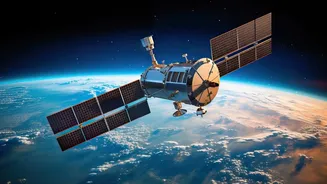
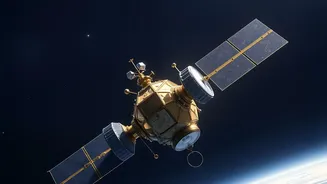
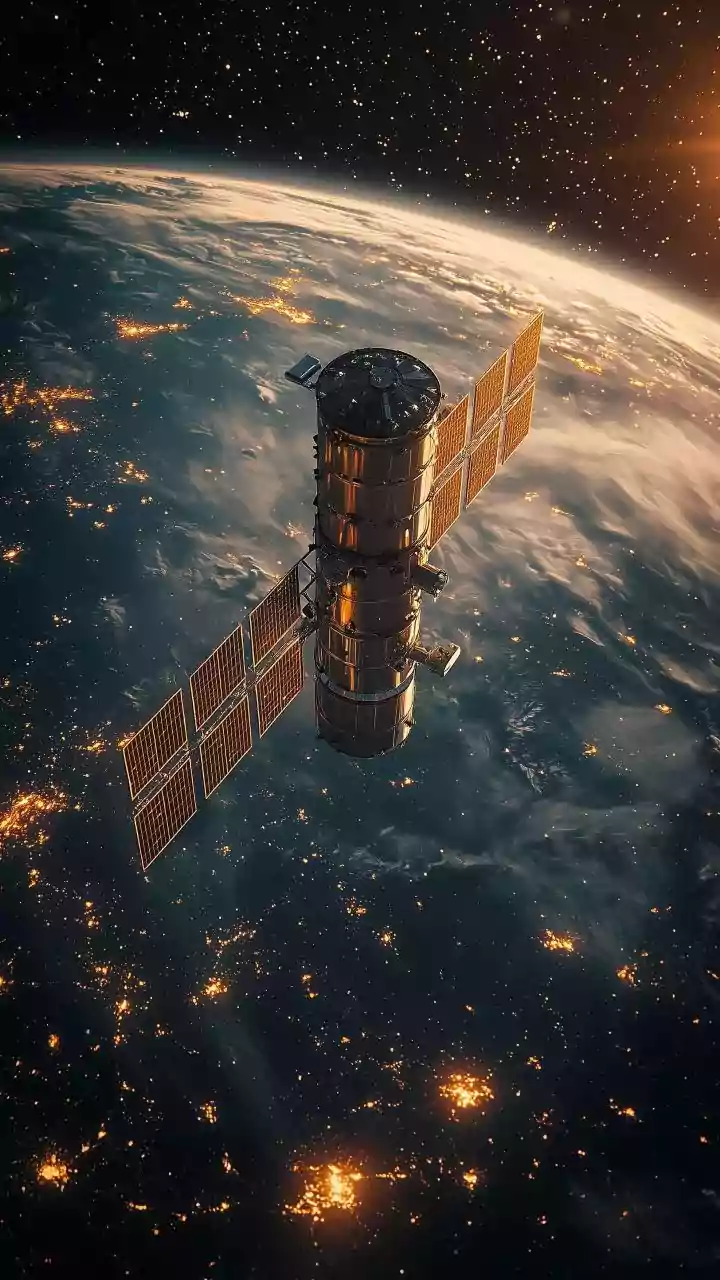
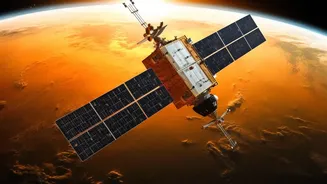
Low Earth Orbit (LEO), home to the International Space Station and thousands of satellites, isn't a perfect vacuum. It contains a tenuous layer of atmospheric gases called the thermosphere. As satellites speed through this region, they collide with gas particles,
creating a frictional force known as atmospheric drag. This force acts like an invisible brake, slowing the satellite down and causing its orbit to gradually lower. If left uncorrected, this orbital decay will eventually cause the satellite to re-enter the atmosphere and burn up. Under normal conditions, satellite operators periodically boost their spacecraft back into a stable orbit, a routine part of mission planning.
The Sun's Violent Outbursts
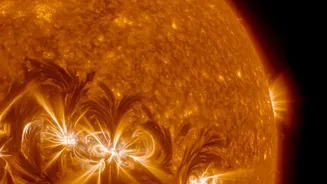
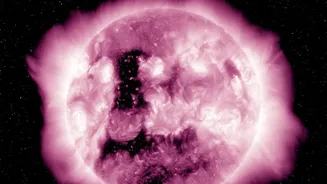
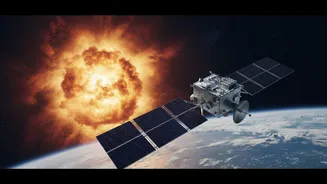
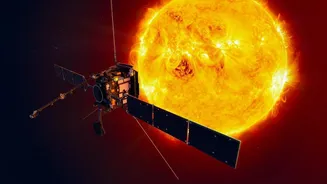
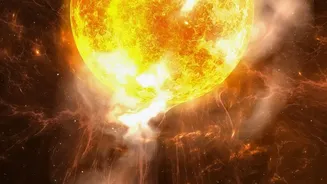
The situation becomes far more unpredictable because of the Sun's volatile nature. Our star periodically unleashes Coronal Mass Ejections (CMEs), which are colossal eruptions of plasma and magnetic fields into space. These solar storms travel at immense speeds and can be directed towards Earth. When a CME strikes Earth's magnetic field, it triggers a geomagnetic storm, the same phenomenon that creates spectacular auroras. But beyond the light show, these events pump a massive amount of energy into our planet's upper atmosphere, with significant consequences for objects in orbit.
How Solar Storms Amplify Drag
The energy from a geomagnetic storm dramatically heats the thermosphere, causing it to expand upwards, much like a marshmallow puffing up over a campfire. This expansion means that the atmosphere at typical LEO altitudes becomes significantly denser. Satellites that were flying through a near-vacuum are suddenly encountering a much thicker medium. This sudden increase in density can multiply the force of atmospheric drag by a factor of ten or more during a major storm. This unexpected braking effect can cause a satellite to drop in altitude far more rapidly than anticipated, increasing the risk of collision with other satellites or space debris and hastening its re-entry. In one notable case in February 2022, a batch of newly launched Starlink satellites was lost after a geomagnetic storm increased atmospheric drag so much that they couldn't reach their operational orbits.
The Science of Forecasting the Drag
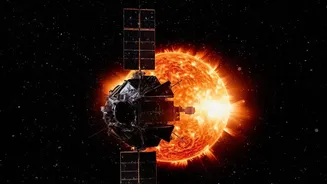
To protect these vital and expensive assets, scientists can't just react to these events—they must predict them. This is where sophisticated computer models come in. When sun-observing satellites detect an Earth-directed CME, space weather forecasters spring into action. They use models like the WSA-ENLIL to forecast the CME's journey through space and its arrival time at Earth, typically providing a one-to-four-day advance warning. The model gets its inputs from observations of the Sun's magnetic field and coronagraph images that detail the CME's initial speed, direction, and size.
From Solar Wind to Satellite Orbit
The WSA-ENLIL model is actually two parts. The first part, WSA (Wang-Sheeley-Arge), models the solar wind environment near the sun. The second, ENLIL, is a 3D magnetohydrodynamic (MHD) model that simulates how the CME cloud propagates through that solar wind to reach Earth. Once the model predicts the CME's impact time and intensity, other physics-based models forecast the resulting changes in the thermosphere. They calculate how much the atmosphere will heat up and expand, providing a crucial forecast of atmospheric density at various LEO altitudes. This tells satellite operators how much extra drag to expect and for how long.
Taking Action to Save Satellites
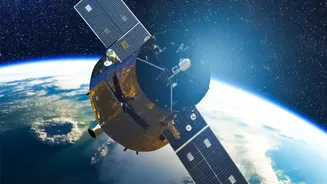
Armed with these predictions, satellite operators can take defensive measures. They might temporarily reorient a satellite to present a smaller cross-section to the direction of travel, minimizing the drag effect. More critically, they can plan for precise engine burns to boost the satellite's orbit, counteracting the increased drag and preventing it from falling too low. These predictions are essential for collision avoidance, as a sudden change in one satellite's orbit can put it on a dangerous path toward another spacecraft or piece of debris. By accurately forecasting drag, these models help extend the operational life of satellites and ensure the stability of the entire LEO ecosystem, which underpins everything from GPS navigation and global communications to weather forecasting.