

A Whisper from the Cosmos
Imagine the universe as a vast, silent ocean. Most of the time, it's calm, but occasionally, cataclysmic events like the collision of two black holes create ripples that travel outward. These are not ripples in water, but in the very fabric of space and
time itself. They are called gravitational waves. First predicted by Albert Einstein a century ago, they were only directly detected in 2015, opening a new window into the universe. These waves are incredibly faint by the time they reach us, but powerful detectors like LIGO and Virgo can 'hear' these whispers from deep space, allowing us to witness events that are otherwise completely invisible. A recent signal has given scientists a front-row seat to one of the most sought-after phenomena in modern astrophysics: the growth of an intermediate-mass black hole.
The Black Hole Family Mystery
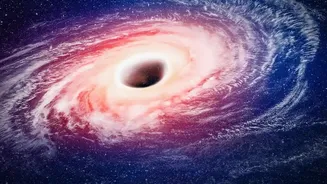
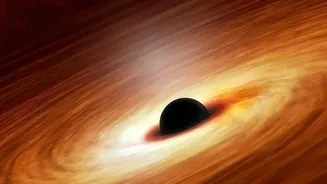
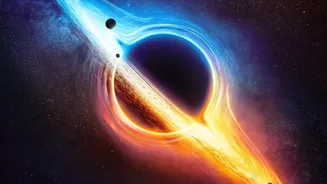
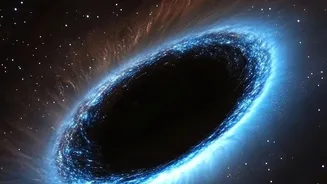
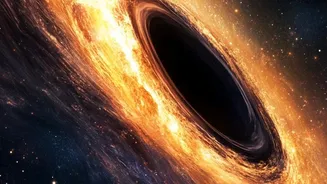
Astronomers have long known about two main types of black holes. First, there are stellar-mass black holes, typically 5 to 50 times the mass of our sun, which form when a single massive star collapses at the end of its life. Then there are the supermassive black holes, giants that are millions or even billions of times our sun's mass, lurking at the heart of nearly every galaxy, including our own Milky Way. But there has always been a gap in the family portrait: the intermediate-mass black holes (IMBHs). These are the cosmic 'teenagers', with masses ranging from a hundred to a hundred thousand times that of the sun. Their existence is a crucial missing link; scientists believe they are the seeds from which supermassive black holes grow, but finding them has been incredibly difficult.
New Signal, Direct Evidence
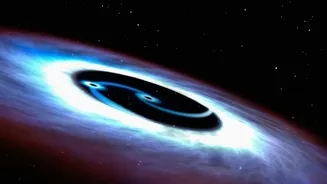
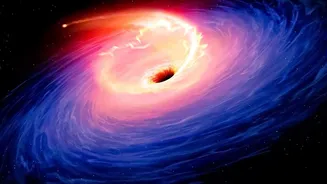
The latest gravitational wave detection changes everything. The signal, captured by the global network of detectors, precisely matches the signature of a smaller, stellar-mass black hole spiraling into and being consumed by a larger, intermediate-mass black hole. This isn't just a merger; it's a live observation of an IMBH in the act of growing by feeding on its smaller cousin. Previous detections, like the groundbreaking GW190521, showed the formation of an IMBH from the merger of two large stellar black holes. This new evidence, however, provides the first direct proof of the subsequent growth phase, a key step in the journey towards becoming a supermassive giant. It confirms a long-held theory that IMBHs grow through a series of mergers and by accreting nearby matter.
Why This Discovery Matters
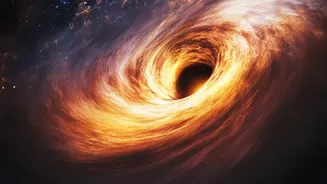
Finding direct evidence of IMBH growth is like finding a fossil of a juvenile T-Rex after only ever seeing hatchlings and full-grown adults. It helps complete the story of cosmic evolution. Understanding how these intermediate objects form and grow is fundamental to understanding how galaxies themselves evolve. The supermassive black holes at their centres exert a huge influence, shaping star formation and the overall structure of the galaxy. By confirming that IMBHs grow through mergers, we get closer to explaining how the universe's first supermassive black holes could have formed so quickly in the early cosmos, a puzzle that has long perplexed astronomers. This discovery validates current models and paves the way for a deeper understanding of the cosmic life cycle, from the first stars to the galactic behemoths we see today.