




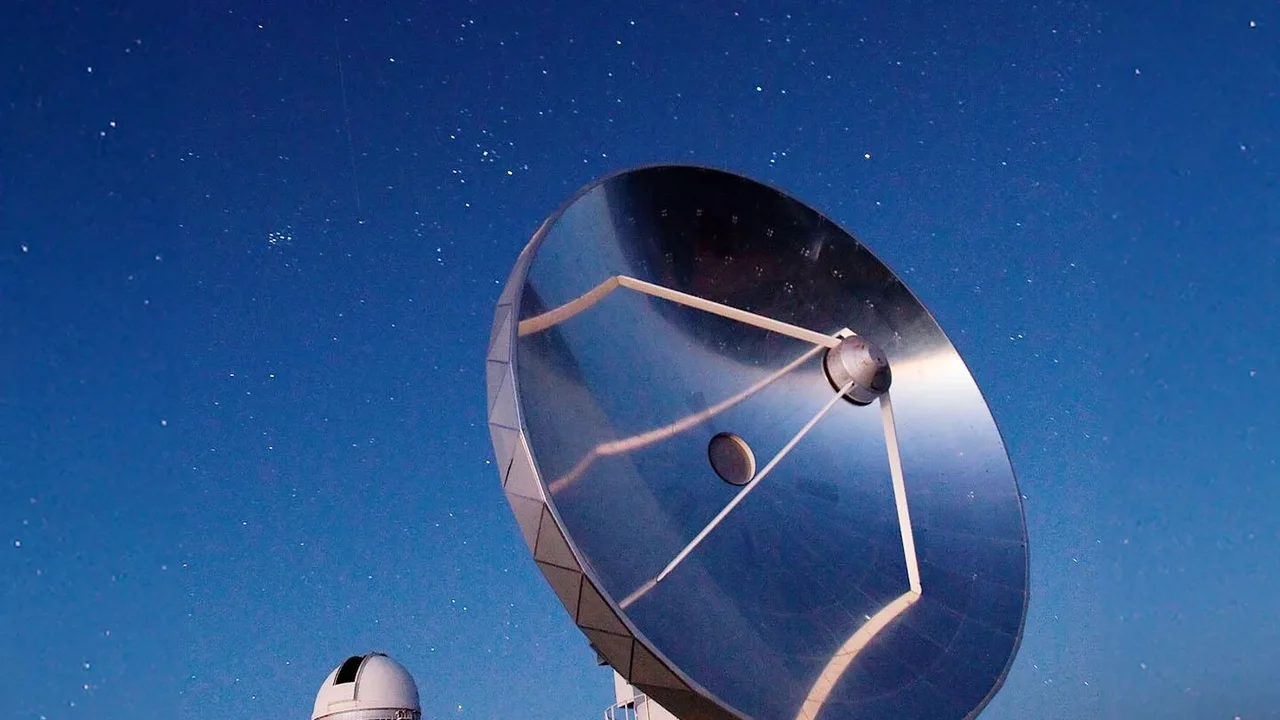

A Telescope the Size of a Continent
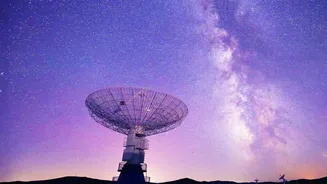
The Square Kilometre Array (SKA) isn't a single telescope but a revolutionary observatory made of two vast networks of antennas. In the remote Western Australian outback, over one hundred thousand tree-shaped antennas make up SKA-Low, poised to catch
the faintest low-frequency radio waves. Thousands of kilometres away, in South Africa's Karoo region, nearly 200 dishes, including the precursor MeerKAT array, form SKA-Mid. Together, these sites will have a combined collecting area of a million square metres, giving them a sensitivity 50 times greater than any radio instrument built before. This immense scale allows astronomers to survey the sky thousands of times faster and in more detail than ever imagined, effectively creating a virtual telescope the size of a continent to peer into the deepest corners of space and time.
Listening for the Cosmic Dawn
The primary mission of the SKA is to answer one of the most fundamental questions: how did the universe light up? After the Big Bang, the cosmos entered a period known as the 'Dark Ages', filled with a fog of neutral hydrogen gas. Then, hundreds of millions of years later, the first stars and galaxies ignited, starting a process called the Epoch of Reionization that transformed the universe from dark and neutral to the transparent, light-filled cosmos we know today. The SKA is engineered to detect the faint radio signal emitted by the neutral hydrogen just before and during this 'Cosmic Dawn'. By capturing this ancient light, scientists hope to create a 3D map, or a 'movie', of the early universe, watching as the first bubbles of light expanded and merged to illuminate everything.
An Unprecedented Data Challenge
A telescope of this magnitude presents an equally massive technological challenge: data. The SKA is projected to generate an astonishing amount of information, estimated at over 700 petabytes annually—more data than all of today's internet traffic combined. Processing this data requires a network of the world's most powerful supercomputers and a global web of SKA Regional Centres (SRCs) dedicated to storing and analysing the information. This 'data tsunami' has pushed the boundaries of computing, engineering, and data science. To prepare, the SKA Observatory has been running a series of 'Data Challenges', tasking scientists worldwide with analysing vast, simulated datasets to develop the advanced algorithms and machine learning techniques needed to handle the real thing.
A Global Scientific Endeavour
Building such a monumental instrument is beyond the scope of any single nation. The SKA Observatory (SKAO) is one of history's great international scientific collaborations, with its headquarters in the UK and a growing list of member states. By 2026, the consortium includes 14 countries, including Australia, South Africa, the UK, China, Canada, and France. India is a significant partner in this global effort, formalising its participation in 2024 with a financial commitment of ₹1,250 crore. Indian scientists and research institutions are deeply involved in developing the critical computational systems required to process the telescope's massive data flow, positioning the nation at the forefront of 21st-century astronomy and big data innovation.
Beyond the Beginning
While its primary goal is to study cosmic origins, the SKA's incredible power will enable breakthroughs across many areas of astrophysics. Scientists will use it to conduct extreme tests of Einstein's theory of general relativity by studying pulsars orbiting black holes. It will map the structure of the cosmos to shed light on the mysterious forces of dark matter and dark energy that drive the universe's expansion. The telescope will also hunt for the complex organic molecules that are the building blocks of life, searching for clues about our own origins in the stellar nurseries of the Milky Way and beyond. From charting cosmic magnetism to spotting explosive cosmic events, the SKA is a versatile discovery machine.