


A New Cosmic Powerhouse
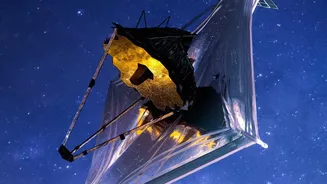
The Nancy Grace Roman Space Telescope, named after NASA's pioneering first chief of astronomy, is the agency's latest flagship mission. After launching aboard a SpaceX Falcon Heavy rocket, it began a million-mile journey to its operational orbit, a stable
point in space known as L2. The bus-sized observatory is now undergoing its commissioning phase, with controllers activating its instruments and preparing it to begin its ambitious science program. Its primary mission is slated to last five years, during which it will fundamentally change our map of the cosmos.
A Universe in a Single Glance
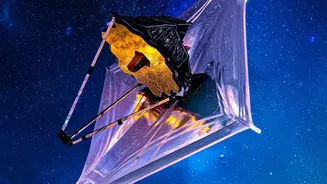
Roman's superpower is its incredible field of view. Its Wide Field Instrument (WFI) can capture a patch of the sky 100 times larger than the Hubble Space Telescope can in a single pointing, but with the same stunning sharpness. Think of it like this: if Hubble and the James Webb Space Telescope (JWST) use a zoom lens to study individual trees in cosmic forests, Roman uses a wide-angle lens to map the entire forest at once. This panoramic capability will allow it to survey vast swathes of the sky with unprecedented speed. In its first five years, Roman is projected to image 50 times more sky than Hubble has in over three decades.
Shining a Light on Dark Energy
One of Roman's primary goals is to tackle one of the biggest mysteries in physics: dark energy. This strange, unidentified pressure is causing the expansion of the universe to accelerate, but scientists don't know what it is or how it works. Roman will approach this puzzle by creating a colossal 3D map of the universe. By surveying over a billion galaxies and thousands of distant supernovae, it will measure how the universe's expansion has changed over cosmic time. This data will provide the most detailed look yet at the influence of dark energy, helping scientists test theories about the ultimate fate of the cosmos.
Hunting for Thousands of New Worlds
Beyond cosmology, Roman is also a powerful planet-hunting machine. It is expected to discover thousands of new exoplanets, or worlds beyond our solar system. It will primarily use a technique called gravitational microlensing, where the gravity of a star or planet bends and magnifies the light of a more distant star that passes behind it. This method is sensitive enough to find planets of various sizes, including so-called 'rogue' planets that drift through space untethered to a star. This massive planetary census will give us a much clearer understanding of how common planets are throughout our galaxy.
A High-Tech Tech Demo
In addition to its main camera, Roman carries a second instrument called the Coronagraph. This device is a technology demonstration designed to block the overwhelming glare of a star, allowing the faint light of orbiting planets to be seen directly. While the Hubble and Webb telescopes can do this to a limited extent, Roman's coronagraph is a major leap forward, designed to see planets that are a billion times fainter than their host stars. It will test advanced technologies that will be crucial for future missions, like the Habitable Worlds Observatory, which aims to one day take direct images of Earth-like planets.