





Seeing the Invisible Universe
It’s easy to think of light as just the colours of the rainbow, but that’s only a sliver of what’s out there. The full range of light, known as the electromagnetic spectrum, includes everything from low-energy radio waves and microwaves to high-energy
X-rays and gamma rays. Most of these are invisible to the naked eye. Different astronomical objects and events shine most brightly in different types of light, depending on how hot and energetic they are. Cool, dusty regions might glow in infrared, while cataclysmic explosions blaze in gamma rays. This is why astronomers have built different kinds of telescopes, some on the ground and some in space, to capture this full range. Looking at an object in only one wavelength is like listening to a symphony with only one instrument playing; you get a part of the performance, but you miss the whole composition. By combining views from different wavelengths, a technique called multi-wavelength astronomy, scientists can piece together a complete and far more detailed picture of what’s happening in the cosmos.
A Cosmic Case Study: The Crab Nebula
To see this idea in action, there’s no better example than the Crab Nebula. Located about 6,500 light-years away, it's the spectacular remnant of a massive star that exploded as a supernova. The event was so bright that astronomers in China and elsewhere recorded it as a “new star” in the year 1054 AD. At the heart of this expanding cloud of gas and dust is the crushed core of the original star, now a super-dense, rapidly spinning neutron star called a pulsar. This pulsar rotates 30 times a second, sweeping beams of radiation across space like a lighthouse. The intricate shape and complex physics of the nebula are driven by the interplay between this central pulsar and the material ejected during the initial explosion. Its fame and brightness make it one of the most studied objects in the sky, and it looks dramatically different at every wavelength.
The Low-Energy View: Radio and Infrared
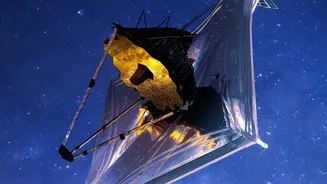
In radio waves, the Crab Nebula reveals the powerful influence of its central pulsar. The view is dominated by something called synchrotron radiation, which is produced by super-fast electrons spiralling within the nebula's intense magnetic fields. A fierce “wind” of charged particles from the pulsar energises the entire structure, causing it to emit these powerful radio waves and showing a web of looping filaments. Moving up in energy to infrared light, the story changes. Telescopes like the Spitzer and James Webb Space Telescope can peer through the obscuring gas to see the glow of dust particles. These particles absorb higher-energy light and re-radiate it as heat, which we detect as infrared. This allows astronomers to map the dust and filamentary structures in a way that’s impossible in other wavelengths, revealing a cage-like structure of fluffy knots.
The Classic View: Visible and Ultraviolet
In visible light, the kind our eyes can see, the Crab Nebula is a breathtaking sight. Hubble Space Telescope images show a sharp, detailed web of hot, gaseous filaments, which are the remnants of the star's outer layers that were blasted into space. The core of the nebula glows with an eerie blue light, which is also synchrotron radiation from electrons careening through magnetic fields. When astronomers shift their view to ultraviolet (UV) light, a different layer of the puzzle emerges. This higher-energy light highlights the hottest and most ionised gas, showing where the most energetic activity is taking place within the smoky, hazy structure. It helps map the chemical composition and shows how a cloud of electrons is being driven by the central pulsar.
The High-Energy Universe: X-Rays and Gamma Rays
To see the most violent processes at work, astronomers turn to X-ray and gamma-ray telescopes. In X-rays, the beautiful, expansive filaments fade away, and the view becomes much more compact and focused on the nebula’s core. Images from the Chandra X-ray Observatory reveal a dynamic system of rings and jets blasting away from the pulsar. These features trace the paths of extremely high-energy particles being flung into the nebula. Gamma rays represent the highest energies of all. The Crab Nebula is one of the brightest persistent sources of gamma rays in the sky. Scientists have even detected astonishing “superflares” from the nebula, which are five times more powerful than any previously seen and are thought to be caused by sudden restructuring of the magnetic field near the pulsar, accelerating electrons to nearly the speed of light.