




Beyond Textbooks and Wind Tunnels
Traditionally, learning aerospace engineering has been a gruelling process. It involves dense textbooks, complex mathematical models, and fleeting access to high-cost physical labs like wind tunnels or engine testbeds. For students in India and around
the world, the gap between theory and practice can be immense. You can read about how an aerofoil generates lift, but you can’t exactly tinker with a Boeing 777 wing in your university workshop. This hands-off approach often makes learning abstract, slow, and for many, incredibly daunting. Mistakes in a physical lab can be catastrophic and expensive, which naturally discourages the kind of experimentation that leads to true understanding. The result is a steep learning curve that can filter out brilliant minds who simply don't thrive on theory alone.
Enter the Virtual Reality Lab
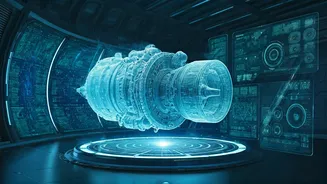
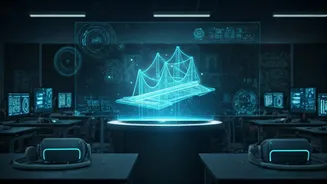
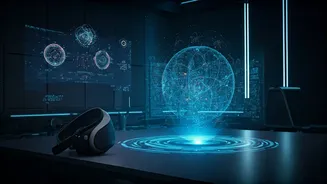
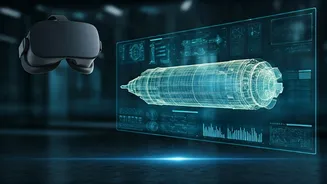
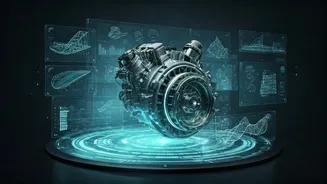
This is where Virtual Reality (VR) classrooms come in. By putting on a headset, a student is no longer in a classroom in Bengaluru or Kanpur; they are standing inside a photorealistic digital twin of a state-of-the-art aerospace lab. They can walk around a jet engine, manipulate its components, and run diagnostic tests. They can design a fuselage and immediately see how airflow behaves around it. This alone is a game-changer. It democratises access to elite-level training equipment, making it available to any student, anywhere. But VR is just the environment. The real magic happens when you add a layer of predictive artificial intelligence.
The AI Co-Pilot in Your Headset
So what does “predictive AI” actually do? Think of it as an expert tutor that lives inside the simulation. This isn't just about the AI knowing the right answers. It’s about the AI understanding the student’s process. It monitors a user’s actions, tracks their gaze, and analyses the decisions they make in real-time. Based on this data, the AI can predict what the student is likely to do next—or, more importantly, what mistake they are about to make. For example, if a student is about to connect a hydraulic line to the wrong port, the system doesn't just flash a red 'ERROR' message. Instead, it might subtly highlight the correct port or provide a contextual pop-up explaining the consequences of the potential mistake, asking, “Are you sure? Connecting here could cause a pressure imbalance.” This proactive guidance turns every misstep into a teachable moment, not a point of failure.
Learning by (Safely) Breaking Things
This brings us to the “fun” part. The combination of a risk-free VR environment and a predictive AI guide transforms learning from a high-pressure test into an engaging exploration. Students are free to experiment. What happens if you push the engine past its theoretical limits? In the real world, that’s a disaster. In VR, it’s a spectacular, safe, and highly educational light show. The AI can also introduce gamified challenges and unexpected scenarios. It might simulate a sudden bird strike, an engine flameout, or a sensor failure, forcing the student to troubleshoot under pressure, just like in a real crisis. By removing the fear of failure and replacing it with the thrill of discovery and problem-solving, these VR labs make one of the world's most complex subjects feel intuitive and exciting. This isn't just about passing an exam; it's about building genuine curiosity and confidence.
Building India’s Next-Gen Engineers
The implications for the industry are massive. Companies like Boeing and Airbus are already using similar technology to train their technicians, drastically reducing training time and cost. For a country like India with a booming aviation and space sector—think ISRO’s ambitious missions and the growth of domestic airlines—this technology is crucial. It can help rapidly upskill a new generation of world-class engineers and technicians. Instead of relying solely on a few premier institutions with expensive physical labs, this tech can be deployed across engineering colleges nationwide, creating a larger, more proficient talent pool. Students graduate not just with theoretical knowledge but with virtual hands-on experience, ready to contribute from day one.