







The Original Blueprint: Destination Pluto
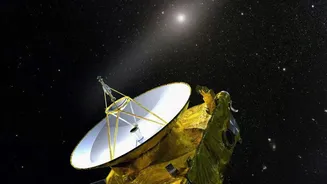
When New Horizons blasted off from Earth, it had a clear and ambitious objective: to conduct the first-ever reconnaissance of Pluto. For decades, Pluto was just a faint, fuzzy dot in our most powerful telescopes. The mission's primary goals, set by NASA
and the scientific community, were to understand this distant world. The main objectives were to map the surfaces of Pluto and its largest moon, Charon, characterize their geology, and study Pluto's thin nitrogen atmosphere. Scientists wanted to know what these icy worlds looked like up close, what they were made of, and how Pluto's atmosphere behaved so far from the Sun. Completing this flyby would mean that the United States had sent a probe to every classical planet in the solar system.
Historic Encounter and Surprising Discoveries
On July 14, 2015, after a journey of nearly a decade, New Horizons flew past Pluto, gathering an unprecedented amount of data. The images it sent back were breathtaking, revealing a world of stunning complexity. Instead of a simple, cratered ice ball, Pluto was shown to have vast nitrogen glaciers, towering water-ice mountains, and a potential subsurface ocean. The iconic image of a giant, heart-shaped plain of ice captured the public's imagination. The probe also studied Pluto’s five moons, finding that Nix and Hydra were primarily made of water ice. In fulfilling its original mandate, New Horizons didn’t just answer old questions; it opened up entirely new ones about the activity and evolution of dwarf planets.
A New Chapter: The Kuiper Belt
With the Pluto flyby complete and the spacecraft in excellent health, the mission was far from over. Its original design always included the possibility of an extended mission into the Kuiper Belt—the vast, doughnut-shaped ring of icy bodies beyond Neptune. This region is considered a relic of solar system formation, holding pristine objects that have remained largely unchanged for billions of years. After the Pluto encounter, NASA approved a new target: a small Kuiper Belt Object (KBO) then known as 2014 MU69, later named Arrokoth. This shifted the mission’s focus from a single, complex dwarf planet to a more ancient, primitive building block of planets.
From Planetary Science to Solar System Origins
The science of the extended mission is fundamentally different. While the Pluto flyby was about understanding a specific world, the Arrokoth encounter on January 1, 2019, was about peering back in time to the dawn of the solar system. Arrokoth, the most distant object ever visited by a spacecraft, turned out to be a 'contact binary'—two objects that gently merged. Its shape and pristine condition provided strong evidence for a leading theory of planet formation, suggesting that planets grew from the gentle accumulation of material rather than violent collisions. The science focus thus broadened from planetary geology to the fundamental mechanics of how planetary systems are born.
The Mission Continues: A Deep Space Observatory
Even after the Arrokoth flyby, New Horizons continues its journey. As of mid-2026, the spacecraft has awakened from hibernation and is serving as a unique deep-space observatory. Its new goals are to study the heliosphere—the vast bubble of charged particles flowing from our sun—and to measure the dust environment of the Kuiper Belt. It is also observing other KBOs from a distance, providing data that can't be obtained from Earth. This 'heliophysics' mission is providing the first-of-its-kind data from this remote region, helping scientists understand the boundary where our solar system meets interstellar space, a feat only achieved previously by the Voyager probes. The mission is expected to continue operating until its power source depletes sometime in the 2030s, pushing the frontiers of exploration ever outward.