




A Solar System in Miniature
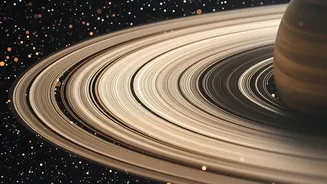
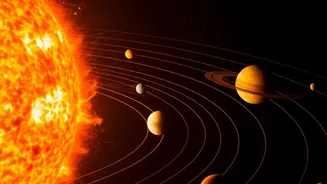
At its most basic level, a planetary ring system is a collection of billions of individual particles, from dust specks to house-sized chunks, all orbiting a central planet. This structure is a direct analogue to our solar system, where planets, asteroids,
and comets orbit the central Sun. Each ring particle follows its own orbital path, with inner particles moving faster than outer ones, just as Mercury completes its orbit faster than Neptune. This fundamental similarity allows scientists to study complex gravitational dynamics on a smaller, more accessible scale. It provides a local laboratory to test theories about how celestial bodies interact in a disk.
Witnessing the Birth of Planets
One of the most profound connections between rings and solar systems is in modeling planet formation. Our solar system is believed to have formed from a vast, rotating cloud of gas and dust known as a protoplanetary disk. Over millions of years, particles in this disk clumped together through a process called accretion, eventually forming the planets we see today. Planetary rings exhibit similar processes. Scientists observe particles clumping together, providing a real-time glimpse into the very first steps of planetary assembly. Features nicknamed 'propellers', which are disturbances created by unseen moonlets, offer direct evidence of how larger bodies can begin to grow within a disk of smaller particles.
The Sculpting Power of Gravity
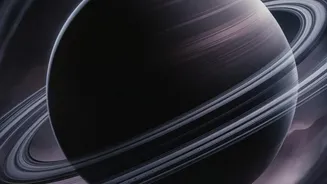
The intricate patterns of gaps and waves seen in Saturn’s rings are not random; they are carved by the gravitational influence of its moons. So-called 'shepherd moons' orbit near the edges of rings, using their gravity to keep the ring particles tightly confined, much like a shepherd herding a flock. Moons can also create gaps through orbital resonance. This happens when a ring particle's orbit is a simple fraction of a moon’s orbit (like one-half or two-thirds), leading to repeated gravitational tugs that clear particles out of that specific path. This is a direct parallel to how Jupiter’s gravity has shaped the asteroid belt, creating gaps and corralling asteroids into groups, and how planets are thought to clear gaps in the disks of dust and gas from which they form.
Cosmic Evolution on Fast-Forward
Perhaps the greatest advantage of studying ring systems is the timescale. The processes of accretion, gravitational sculpting, and particle collision that take millions or even billions of years in a developing solar system happen much more rapidly within rings. The wakes created by a moon passing through a ring section, which are visible ripple effects, can be observed over months or years, not eons. This accelerated pace allows astronomers to watch theories of planetary dynamics play out in real time. The Cassini mission, for example, provided a wealth of data by observing these rapid changes, helping to refine models of how moons and rings interact.
A Universal Phenomenon
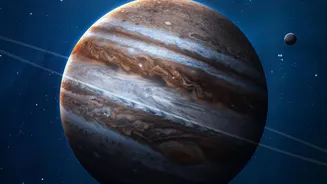
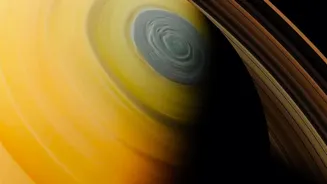
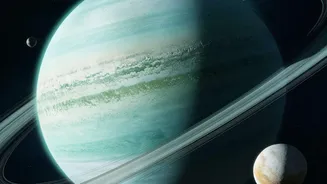
While Saturn's are the most famous, all four giant planets in our solar system—Jupiter, Saturn, Uranus, and Neptune—possess ring systems. Each is unique in its composition and structure, from Jupiter's faint, dusty rings to Uranus's narrow, dark bands. This diversity provides scientists with multiple models to study. Furthermore, observations of distant young stars with the ALMA telescope have revealed that ring-like structures are common in protoplanetary disks throughout the galaxy. This suggests that the same physical principles shaping Saturn’s rings today are at play across the cosmos, guiding the formation of new solar systems.