




The Fiery Problem of Arrival
Any object entering a planet's atmosphere at orbital speeds faces an immense challenge. Hurtling at thousands of kilometres per hour, the vehicle compresses the air in front of it, generating incredible friction and temperatures that can reach thousands of degrees
Celsius. Without protection, any probe or capsule would be incinerated in moments. For decades, the solution has been rigid heat shields. These are typically heavy, ablative shields that burn away in a controlled manner or heat-resistant tiles that insulate the spacecraft. While effective, these traditional shields have a major limitation: their size is constrained by the diameter of the rocket fairing they launch in. This fundamentally limits the size and weight of payloads we can land, especially on planets with thin atmospheres like Mars.
A New Solution: Just Add Air
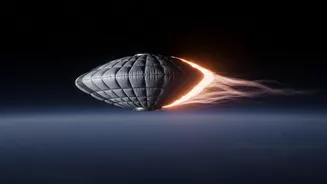
Enter the Hypersonic Inflatable Aerodynamic Decelerator, or HIAD. It’s a revolutionary concept that swaps rigid materials for a deployable system that can be packed into a small volume for launch and then inflated to a massive size just before atmospheric entry. The structure is made of stacked rings, or tori, woven from synthetic polymers that are incredibly strong—some up to 15 times stronger than steel by weight. This inflatable structure is covered by a flexible thermal protection system, a multi-layered blanket of advanced heat-resistant fabrics and insulation designed to withstand the brutal heat of re-entry. This allows the HIAD to function like a combination of a giant brake and a heat shield, all in one foldable package.
Bigger, Lighter, and More Capable
The primary advantage of an inflatable heat shield is its ability to deploy to a diameter much larger than any rigid shield. A larger surface area creates more drag, making it far more effective at slowing down a spacecraft at higher, thinner altitudes. This reduces the peak heating and mechanical stress the vehicle endures. The technology is also lighter and more mass-efficient, which is a critical consideration in spacecraft design where every kilogram counts. By allowing for larger shields, HIADs open the door to landing much heavier payloads—think large rovers, habitats for human missions, or entire rocket stages for reuse—on planets like Mars. It also enables access to high-altitude landing sites on Mars that are currently unreachable because the thin atmosphere doesn't provide enough braking power for conventional systems.
Proof of Concept: The LOFTID Mission
This technology is not just theoretical. In November 2022, NASA successfully demonstrated a HIAD with its Low-Earth Orbit Flight Test of an Inflatable Decelerator (LOFTID) mission. Launched as a secondary payload, the 6-meter diameter LOFTID vehicle inflated in space and re-entered Earth's atmosphere at over 29,000 kilometres per hour. It survived the intense journey, successfully slowed down, deployed its parachutes, and splashed down in the Pacific Ocean, where it was recovered in excellent condition. The test was declared a huge success, proving that the inflatable structure could withstand the extreme forces and heat of hypersonic entry. The data gathered from its many sensors is now being used to design future missions.
India's Leap into Inflatable Decelerators
India's own space ambitions are also embracing this cutting-edge technology. In September 2022, the Indian Space Research Organisation (ISRO) successfully tested its own Inflatable Aerodynamic Decelerator (IAD). Launched aboard a Rohini sounding rocket from Thumba, the IAD was inflated at an altitude of 84 kilometres. Made from Kevlar fabric with a special coating, it systematically reduced the payload's velocity through aerodynamic drag, performing exactly as predicted. ISRO Chairman S. Somanath called the technology a gateway for cost-effective recovery of spent rocket stages and a key enabler for future missions to Mars and Venus. This successful demonstration places ISRO among the select few space agencies actively developing this transformative technology.