

A 'Hat-Trick' of Perfect Landings
In a remarkable display of precision engineering, the Indian Space Research Organisation (ISRO) successfully conducted the third and final test in its Reusable Launch Vehicle Landing Experiment (RLV-LEX) series. The test, which took place at the Aeronautical
Test Range in Chitradurga, Karnataka, involved the winged vehicle 'Pushpak' being lifted to an altitude of 4.5 kilometres by an Indian Air Force Chinook helicopter and then released. From there, the unmanned vehicle autonomously navigated its way to the runway, corrected its course against severe winds, and executed a flawless horizontal landing at a high speed of over 320 kmph. This final test was the most challenging yet, with the vehicle being released 500 meters away from the runway, forcing it to perform complex manoeuvres to achieve a perfect touchdown. With this 'hat-trick' of successes, ISRO has validated the critical autonomous landing technology needed for a reusable spaceplane.
Meet Pushpak, India’s Space Shuttle
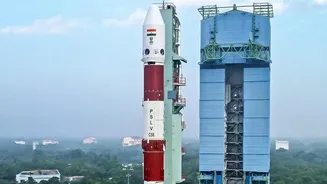
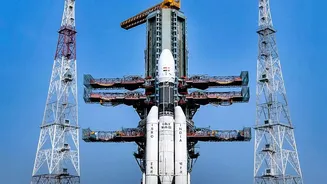
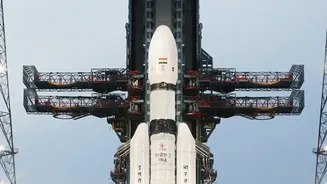
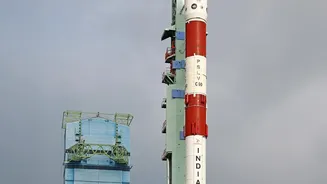
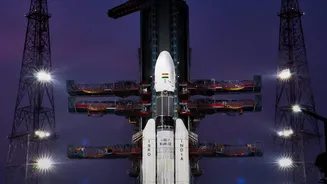
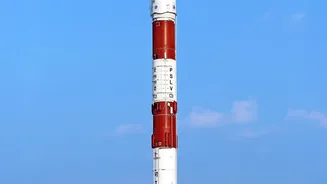
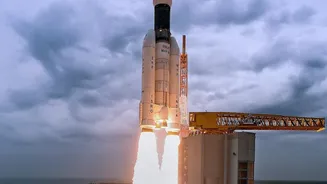
The star of these trials is the Reusable Launch Vehicle-Technology Demonstrator (RLV-TD), affectionately named 'Pushpak' after the mythical flying palace from the Ramayana. This vehicle is the cornerstone of ISRO's ambitious plan to drastically reduce the cost of launching satellites and other payloads into space. Unlike ISRO's workhorse rockets like the PSLV and GSLV, which are expendable after a single use, Pushpak is designed to fly into space, deploy its payload, re-enter the atmosphere, and land on a runway, ready for its next mission. The current prototype is a scaled-down version, but it serves as a crucial testbed for the technologies required to build a full-scale, operational Two-Stage-To-Orbit (TSTO) launch vehicle in the future. The goal is to make space access more like air travel—routine, reliable, and, most importantly, affordable.
The Quest for Cheaper Space Access
Why is reusability such a big deal? Currently, the majority of the cost of a space launch is tied up in the rocket hardware, which is discarded into the ocean or burns up in the atmosphere after its job is done. This is like throwing away an entire airplane after just one flight. By developing a reusable system like Pushpak, ISRO aims to recover the most expensive parts of the launch vehicle, particularly the upper stage with its complex electronics and propulsion systems. The target is to slash the cost of putting a kilogram of payload into orbit by up to 80 percent. This dramatic cost reduction would not only save money on national missions but would also position India as a highly competitive player in the multi-billion dollar global satellite launch market. Cheaper access to space opens up a world of possibilities, from launching more scientific missions to deploying large constellations of communication satellites.
From Landing Trials to Orbit
While the successful landing experiments are a massive achievement, they are just one piece of a much larger puzzle. The RLV-LEX series focused solely on mastering the final phase of the mission: the autonomous high-speed landing. With this phase now validated, ISRO's focus will shift to the next logical step: an orbital re-entry vehicle (ORV) mission. This will involve launching a scaled-up version of Pushpak into orbit on a rocket, having it circle the Earth, and then testing its ability to survive the fiery re-entry through the atmosphere before gliding back for a runway landing. This next phase, which will integrate the learnings from the hypersonic flight experiment (HEX) conducted in 2016 and the recent landing trials, will be the true test of India's reusable launch vehicle ambitions.