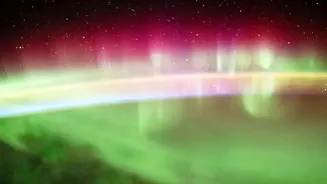







The aurora is one of nature’s most dazzling light shows. But these shimmering curtains of light are more than just a pretty display; they are the visible signs of a powerful cosmic process that connects directly to the stability of our power grids.
An Invisible Magnetic Shield
Earth
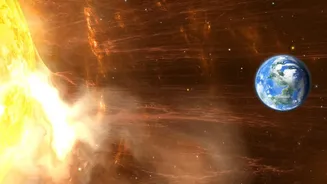
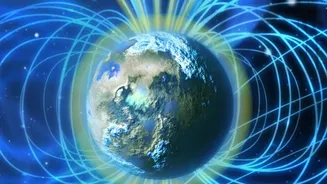
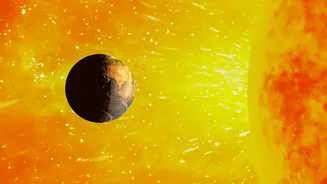
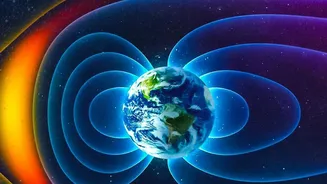
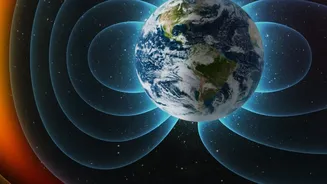
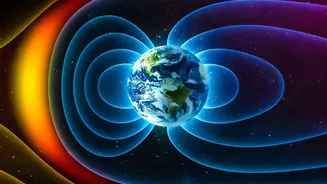
is constantly bathed in the solar wind, a stream of charged particles flowing from the Sun. Our planet is protected from this bombardment by the magnetosphere, a vast magnetic bubble generated by the molten iron in Earth's core. This shield is not symmetrical. On the side facing the Sun, it is compressed by the solar wind. On the night side, it is stretched out into a long, tail-like structure called the magnetotail, which extends hundreds of thousands of kilometres into space. This magnetotail acts like a giant cosmic battery, storing enormous amounts of energy from the solar wind.
A Snap in the Tail
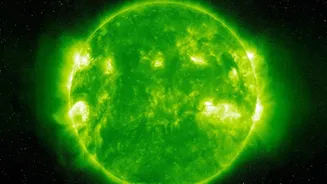
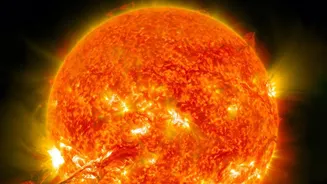
Occasionally, the Sun ejects a massive cloud of particles and magnetic fields known as a coronal mass ejection (CME). When a CME strikes our magnetosphere, it can cause the stretched magnetic field lines in the magnetotail to snap and reconnect in an explosive process called a magnetic substorm. This event unleashes a torrent of stored energy and high-speed particles. These energetic particles are funnelled along Earth's magnetic field lines towards the polar regions. When they collide with oxygen and nitrogen atoms in the upper atmosphere, they cause the gases to glow, creating the beautiful and dynamic auroral displays we see in the sky.
From the Sky to the Ground
The aurora itself is just a visible symptom of a much larger electrical event. The same rush of particles that creates the lights also drives powerful electrical currents in the ionosphere, hundreds of kilometres overhead. According to Faraday's law of induction, any rapid change in a magnetic field induces an electrical current in a nearby conductor. As the atmospheric currents surge and shift, they cause fluctuations in Earth's magnetic field at ground level. This, in turn, induces unwanted electrical currents in the ground itself. These are known as geomagnetically induced currents, or GICs.
The Threat to Our Grids
Long conductors, like high-voltage power lines, oil and gas pipelines, and even railway tracks, become unintentional antennas for GICs. Power grids are designed to operate on alternating current (AC), but GICs are quasi-direct current (DC). When this rogue DC flows into high_voltage transformers, it can cause their magnetic cores to saturate. This leads to rapid overheating, generation of disruptive harmonics, and increased reactive power consumption, which can destabilise the grid. In a severe event, protective relays can trip, causing widespread blackouts, or transformers can be permanently damaged, leading to costly repairs and extended outages that could take months to fix. The most famous example is the 1989 storm that caused a nine_hour blackout for six million people in Quebec, Canada.
Why This Research Matters for India
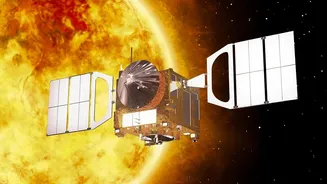
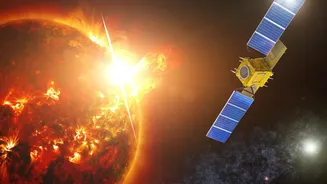
While the most intense auroras occur at high latitudes, strong geomagnetic storms can have global effects. Even for a country like India, which is near the magnetic equator, the risk is not zero. India's national power grid features long transmission lines that can be susceptible to GICs during a severe storm. Furthermore, our increasing reliance on technology, from the Gaganyaan human spaceflight mission to the NavIC satellite navigation system and a growing fleet of over 50 satellites, makes understanding and forecasting space weather a national priority. ISRO's Aditya_L1 solar observatory is playing a crucial role in providing advance warnings of solar eruptions, giving grid operators and satellite controllers precious time to take protective measures against these cosmic threats.