



Anatomy of a Mountain Flood
The devastating flash floods that recently struck the border region of Nepal and China, killing over 150 people, were not caused by monsoon rains, but likely by an avalanche from a glacier. Experts believe a huge mass of ice and rock broke away high in the Himalayas,
blocking a river and leading to a sudden, massive release of water. This type of event is broadly known as a Glacial Lake Outburst Flood (GLOF), a term for the sudden release of water from a lake dammed by ice or glacial debris. These floods are characterised by immense speed and power, with water levels in Nepal's Trishuli river reported to have risen by nine metres in just half an hour, carrying a destructive wave of mud and boulders downstream.
From Stable Ice to Unstable Lake
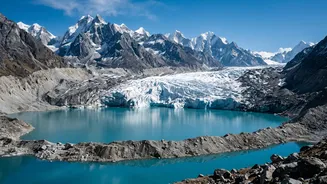
The process begins silently as global temperatures rise. Across the Himalayas, glaciers are melting and retreating at an accelerated pace. This meltwater doesn't just disappear; it often pools in front of or on top of the glacier, forming vast glacial lakes. These lakes are frequently held in place only by unstable natural dams made of moraine—a loose mixture of soil, rock, and ice left behind by the retreating glacier. As the lake grows, the pressure on this fragile dam increases. A trigger event, such as a rockfall, a chunk of the glacier calving into the water, or even an earthquake, can cause the moraine dam to fail abruptly.
A Himalayan Ticking Time Bomb
When the dam breaches, a torrent of water is unleashed. Unlike a normal flood, a GLOF is a thick, slurry-like flow of water, mud, ice, and rocks that moves with incredible force, destroying bridges, roads, and entire villages in its path. The Himalayas are particularly susceptible to these events. The region is warming faster than the global average, leading to the rapid formation and expansion of thousands of glacial lakes. One 2018 study mapped over 25,000 glacial lakes across the Hindu Kush Himalaya region. With climate change predicted to intensify, the frequency and scale of these outbursts are expected to increase, posing a grave threat to millions living downstream.
A Shared Threat for India
This is not a problem confined to Nepal. The Himalayan glaciers are the 'water towers of Asia', feeding ten of the continent's largest river systems, including the Ganges and Brahmaputra, which are lifelines for hundreds of millions in India. The same geological and climatic conditions that create GLOF risks in Nepal exist in Indian states like Uttarakhand, Himachal Pradesh, Sikkim, and Arunachal Pradesh. After the recent Nepal disaster, flood alerts were issued for downstream areas in Bihar and Uttar Pradesh. These events highlight a shared vulnerability across the region, where a disaster in one country can have immediate and severe consequences for its neighbours. India itself has witnessed similar tragedies, underscoring the urgent need for cross-border cooperation on monitoring and early warning systems.