
A Groundbreaking Confirmation
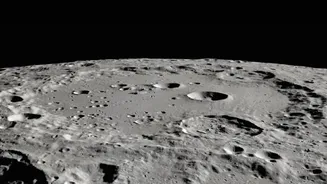
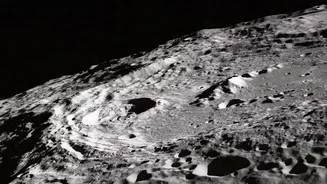
For decades, scientists have theorised that water, in the form of ice, could be trapped in the frigid, permanently shadowed craters of the lunar poles. Over the last two decades, a series of missions have turned this theory into fact. India's Chandrayaan-1,
with NASA's Moon Mineralogy Mapper (M3), provided some of the first direct evidence in 2008, detecting signs of water across the surface. Subsequent missions, like NASA's Lunar Reconnaissance Orbiter (LRO), have built on this, creating increasingly detailed maps. More recent analyses and new sensor data have solidified our understanding, moving from simple confirmation to detailed mapping of its distribution. This is the critical data mission planners need, showing not just that water exists, but where it is concentrated and potentially accessible. These studies confirm that while some water is thinly spread even on sunlit surfaces, the most significant deposits are located in the ultra-cold polar regions.
Why Water Is the Moon's Gold
The presence of water is the single most important factor for enabling a long-term human presence on the Moon. Its value extends far beyond just providing drinking water for astronauts. Through a process called electrolysis, water (H₂O) can be split into its core components: hydrogen and oxygen. Oxygen can be used to create breathable air within a lunar habitat, a fundamental requirement for survival. Even more critically, liquid hydrogen and liquid oxygen are the primary components of modern rocket fuel. Having access to a local source means that a lunar outpost could effectively become a refuelling station for missions venturing further into the solar system, such as to Mars. This concept, known as in-situ resource utilization (ISRU), would dramatically reduce the cost and complexity of deep-space exploration by eliminating the need to launch every drop of water and every litre of fuel from Earth.
From Educated Guesses to Detailed Blueprints
Early evidence for lunar water came from missions in the 1990s that provided tantalizing but low-resolution hints. The major breakthrough came with India's Chandrayaan-1, which carried sensors that could detect the specific signature of water molecules. Later, NASA's LCROSS mission intentionally crashed a probe into a shadowed crater, sending up a plume of material that was analysed and confirmed to contain water ice. Today, advanced deep space sensors aboard orbiters like the LRO and South Korea's Pathfinder Lunar Orbiter continue to map the poles in unprecedented detail. These instruments don't see the ice directly but can detect hydrogen concentrations or use highly sensitive cameras to peer into the faint light of permanently shadowed regions. This cumulative data allows scientists to create prospectivity maps, similar to those used in mining on Earth, that show the most promising locations to find accessible ice.
A New Space Race Focused on the South Pole
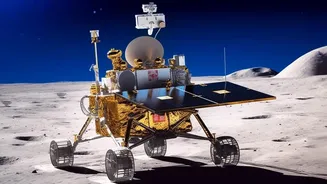
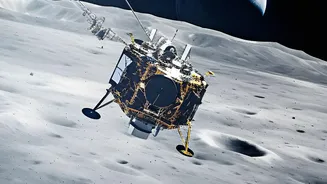
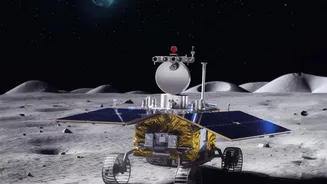
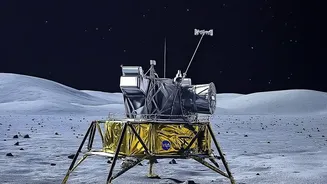
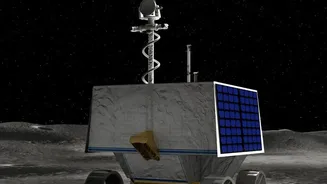
This detailed understanding of water ice distribution has ignited a global rush to the Moon's South Pole, which is believed to hold the most abundant and accessible reserves. NASA's Artemis program has explicitly targeted this region for its upcoming crewed landings, with the goal of establishing a permanent base camp. China and Russia have also announced joint plans for a lunar outpost in the same strategic area. India is a key player in this pursuit. The historic landing of Chandrayaan-3 near the south pole was a monumental achievement, and the Chandrayaan-2 orbiter continues to use its advanced radar to map water ice at greater depths. Furthermore, India's space agency, ISRO, is collaborating with Japan's JAXA on the LUPEX mission, a robotic rover designed specifically to explore the polar region and further quantify its water resources. This international focus underscores the immense strategic and scientific value placed on the Moon's frozen water.