







Go Beyond the Basic Bulb
The first step in this transformation is understanding what makes smart lighting ‘smart’. Unlike a standard bulb, a smart bulb connects to your Wi-Fi, allowing you to control it from your phone or with your voice via assistants like Alexa or Google Assistant.
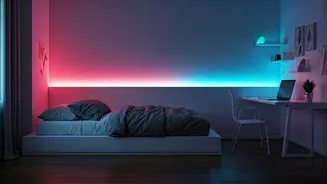
This means you can change its brightness, and most importantly, its colour. You can invest in smart bulbs that fit your existing lamps or explore options like LED light strips, which are perfect for tucking behind headboards or under bed frames. The goal isn't just to illuminate a room; it's to paint it with light, creating an atmosphere that can be changed in an instant without picking up a brush.
Master the Psychology of Colour
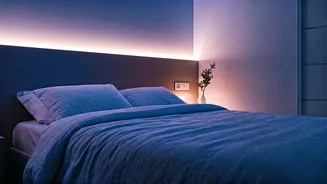
Colour has a profound effect on our mood, and smart lighting gives you an entire spectrum to play with. This isn’t just about aesthetics; it’s about leveraging basic colour psychology. Warm colours like soft yellows, oranges, and reds evoke feelings of comfort, coziness, and relaxation, making them perfect for winding down in the evening. In contrast, cool colours like light blues and whites mimic daylight, promoting alertness and focus, which can be useful for waking up in the morning. A gentle, deep blue or a soft purple can create a serene, almost meditative environment, perfect for a ‘chill sanctuary.’ Start by thinking about how you want to feel in your room at different times of the day, and choose your colours accordingly.
Layer Your Lighting Like a Designer
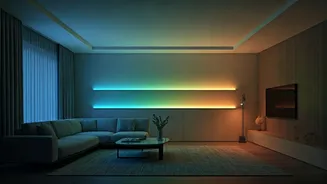
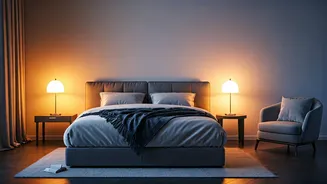
Professional interior designers use a technique called layering, and you can too. Instead of relying on a single, harsh overhead light, aim for three layers. Start with ambient light—the overall illumination of the room, which could be a smart bulb in a ceiling fixture set to a soft, warm glow. Next, add task lighting for specific activities, like a dimmable smart lamp on your bedside table for reading. Finally, introduce accent lighting to create depth and visual interest. This is where smart lighting truly shines. Use an LED strip to backlight your TV or headboard, or place a small, colour-changing lamp on a shelf to highlight a piece of art. In a compact room, these layers prevent the space from feeling flat and one-dimensional.
Create 'Scenes' for Every Activity
The true magic of smart lighting is in creating ‘scenes’—pre-set lighting recipes you can activate with a single tap or voice command. Instead of manually adjusting multiple lights, you program a perfect combination and save it. For instance, a “Movie Night” scene could dim the main lights, turn on the accent backlighting behind the screen, and set it to a deep blue. A “Wind Down” scene might shift all lights to a warm, candle-like orange and lower them to 30% brightness. You can create a “Wake Up” scene that slowly brightens with cool-toned light to gently rouse you from sleep. These automated moods make it effortless to transform your room’s entire vibe to match what you’re doing.
Use Light to Create an Illusion of Space
In a compact bedroom, lighting can be your best friend for making the space feel bigger. A key trick is uplighting. By pointing a light source upwards, you draw the eye toward the ceiling, creating a sense of height and airiness. Place a smart lamp on the floor behind a plant or a chair and aim it at the ceiling. Another powerful technique is washing a wall with light, which you can do with an LED strip along the top or bottom of a wall. This makes the wall seem to recede. Placing lights behind furniture, like under the bed or a dresser, creates a floating effect that adds depth and makes the room feel less cluttered and more open.
Sync Your Lighting to Your Body Clock
Beyond just mood, smart lighting can support your natural sleep-wake cycle, or circadian rhythm. Our bodies are conditioned to respond to light cues—bright, blue-ish light signals daytime and energy, while dim, warm light signals that it's time to rest. Most smart lighting apps allow you to schedule these changes. Program your lights to be bright and cool in the morning to help you feel awake and energized. As the evening progresses, have them automatically shift to warmer, dimmer tones. This simple automation can help your body wind down naturally, potentially improving your sleep quality and making your bedroom a true sanctuary for rest and recovery.