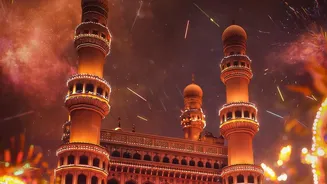





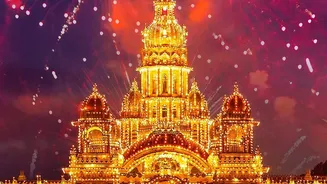
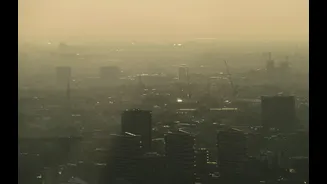
As the festive lights of Diwali prepare to illuminate India, they are often followed by a familiar, choking smog. 'Green crackers' were introduced as the scientific solution, but as celebrations near, the debate over their efficacy intensifies.
What Makes a Cracker 'Green'?
First,
let's be clear: green crackers are not pollution-free. They are an improvement, not a magic wand. Developed by the Council of Scientific and Industrial Research-National Environmental Engineering Research Institute (CSIR-NEERI), these fireworks are designed to have a smaller environmental footprint. Their key feature is a modified chemical composition that reduces particulate matter emissions by at least 30% compared to traditional crackers. This is achieved by eliminating or reducing highly toxic chemicals like barium nitrate, arsenic, and lead. Instead, they use formulations that produce fewer emissions. CSIR-NEERI has developed several types, such as SWAS (Safe Water Releaser), which releases water vapour to suppress dust, and SAFAL (Safe Minimal Aluminium). To help consumers identify them, genuine green crackers are supposed to feature a QR code and a CSIR-NEERI logo, allowing for verification.
The Regulations on Paper
The legal framework around firecrackers is a complex web of court orders and state-specific rules. Following a landmark 2018 Supreme Court case, the manufacture and sale of conventional crackers were banned, permitting only reduced-emission green crackers. The court also set specific time windows for bursting crackers, typically between 8 PM and 10 PM on Diwali night, though this can vary. However, the rules are not uniform across the country. Many states and Union Territories, particularly the heavily polluted Delhi-NCR region, often impose a complete ban on all types of firecrackers ahead of Diwali, depending on the prevailing air quality. For Diwali 2026, the Supreme Court has indicated it will not issue a blanket ban but will likely maintain a framework of restricted hours and permissible cracker types, pending further scientific assessments of certain chemical formulations.
A Market of Smoke and Mirrors
Here lies the core of the problem: enforcement. Despite the regulations, the market is flooded with illegal, conventional firecrackers. Recent weeks have seen massive seizures of banned fireworks across the country, from Delhi to Chittorgarh, often manufactured in secret, unlicensed units. These illegal crackers are frequently mislabeled and sold as 'green crackers' to unsuspecting buyers, making it incredibly difficult for the average person to tell the difference. Police have noted the challenges in identifying counterfeits, as the QR code system is not foolproof and can be easily replicated. This black market not only undermines the environmental goals but also poses significant safety risks due to the lack of quality control in illegal manufacturing.
The Question of Real Impact
Even if every single cracker burst were a genuine green cracker, would it solve the pollution problem? Experts say no. A 30% reduction in emissions per cracker is a positive step, but it doesn't mean the air remains clean. When millions of green crackers are burst simultaneously in a dense urban area, the cumulative pollution can still push the Air Quality Index (AQI) into the 'severe' or 'hazardous' category. Environmentalists caution that the 'green' label can be misleading, creating a false sense of security that these crackers are harmless. They are best seen as a transitional technology—better than the alternative, but not a final solution. The sheer volume of crackers burst during the festival period means that even lower-emission varieties contribute significantly to the toxic smog that blankets cities post-Diwali.
Beyond the Cracker Conundrum
Focusing solely on firecrackers misses the bigger picture. The severe air pollution seen in North India during winter is a complex issue driven by multiple factors, including stubble burning in neighbouring agricultural states, vehicular emissions, industrial pollution, and meteorological conditions that trap pollutants close to the ground. While firecrackers cause a dramatic and dangerous spike in pollution, they are an episodic addition to an already critical problem. A sustainable solution requires a year-round, multi-pronged strategy that addresses all major pollution sources. Many are now advocating for a cultural shift towards community-based celebrations like laser shows and other non-polluting forms of marking the festival of lights, moving the focus away from individual pyrotechnics.