


A Galaxy Transformed
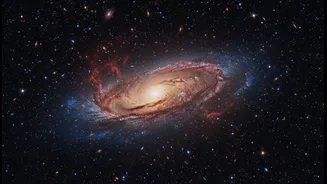
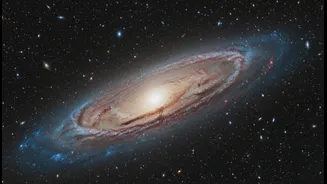
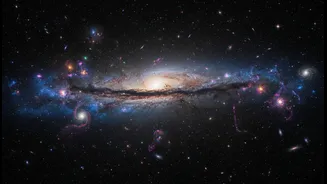
The new image of Centaurus A, released by NASA and its partners to celebrate the fourth anniversary of Webb's scientific operations, is far more than just another pretty picture. Located about 11 million light-years away, this galaxy has long been a subject
of fascination and debate for astronomers. Previous telescopes, like Hubble, struggled to see past the thick veils of cosmic dust that shroud its core. But Webb's powerful infrared vision cuts through that dust, transforming our view of Centaurus A from a familiar celestial object into a complex, dynamic environment teeming with detail we've never seen before. What was once partially obscured is now a vivid landscape of galactic archaeology, with each point of light telling a story.
What Exactly Are We Seeing?
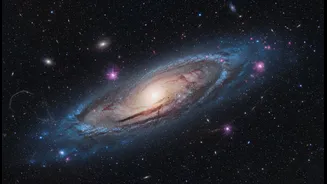
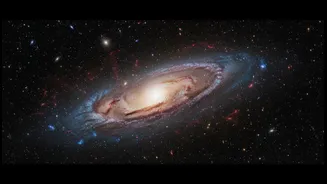
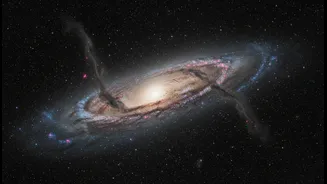
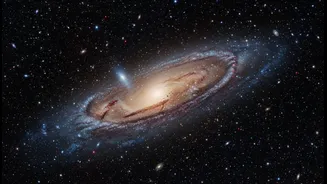
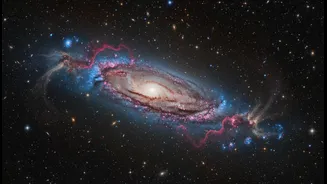
The image is a composite masterpiece, combining data from Webb’s Near-Infrared Camera (NIRCam) and Mid-Infrared Instrument (MIRI). What might look like digital noise or graininess is actually a dense field of millions of individual stars, now resolvable for the first time. The most striking features include a warped, parallelogram-shaped band of glowing dust and gas cutting across the galaxy's heart. This structure is the chaotic remnant of a violent collision with another galaxy that occurred some two billion years ago. This ancient merger fueled intense bursts of star formation, and the raw material it left behind is still being devoured by the supermassive black hole at the galaxy's center, which blasts out powerful jets of energy.
The Science Behind the Spectacle
This new view of Centaurus A is a cosmic laboratory for studying how galaxies and black holes evolve together. Webb’s ability to resolve individual stars allows scientists to create a timeline of the galaxy's history—pinpointing when older stars formed, when star birth paused, and when new generations of stars were born from the collision's aftermath. Astronomers are particularly intrigued by a mysterious 'S'-shaped structure revealed by the MIRI instrument, a feature whose origin is not yet understood. By studying the motion of gas near the central black hole, scientists hope to learn more about how these cosmic engines can both trigger and suppress the formation of new stars, a key process in determining a galaxy's fate.
Four Years of Cosmic Wonder
This anniversary image is a fitting tribute to a mission that has consistently exceeded expectations since its first images were released in July 2022. In just four years, Webb has reshaped our understanding of the universe. It has peered back to witness some of the earliest galaxies ever formed, detected the atmospheres of exoplanets orbiting distant stars, and delivered stunning new views of objects within our own solar system. Each discovery builds on the last, from finding a black hole that formed before its host galaxy to identifying the most distant supernova ever recorded. This image of Centaurus A continues that legacy, turning a known galaxy into a new frontier for discovery.