



The Challenge of Big Data
For decades, NASA has been our eye in the sky, monitoring everything from polar ice caps to forest cover. This has resulted in a national asset: an enormous archive of Earth science data. However, the sheer volume—currently around 180 petabytes and growing
rapidly—presents a huge challenge. Manually analysing this data is like trying to drink from a firehose. Scientists need faster, more efficient ways to find the critical signals of climate change hidden within the noise, a task for which artificial intelligence is uniquely suited.
Enter the Foundation Model
To tackle this, NASA has partnered with tech giant IBM to develop powerful new AI systems known as 'foundation models'. Think of a foundation model as a multi-talented intern who has already studied a vast library of general knowledge. Instead of being trained for one specific task, these models are pre-trained on enormous, unlabelled datasets. For example, the Prithvi-weather-climate model, whose name comes from the Sanskrit word for Earth, was trained on 40 years of NASA's global weather and climate data. This allows it to learn the fundamental patterns of our planet's systems. Scientists can then rapidly fine-tune it for specific tasks, like tracking hurricanes or predicting heatwaves, with minimal extra effort.
From Raw Data to Actionable Insights
The impact of this technology is transformative. By making these advanced models open-source and publicly available on platforms like Hugging Face, NASA and IBM are democratising climate science. Researchers worldwide can now access these tools to study regional climate impacts, from forecasting wildfire behaviour to assessing solar radiation for renewable energy projects. One early success involved fine-tuning a geospatial model to identify floodwaters and map burn scars from wildfires with incredible speed and accuracy. This ability to quickly turn satellite imagery into actionable information is crucial for disaster response and mitigation efforts.
Smarter Satellites in Orbit
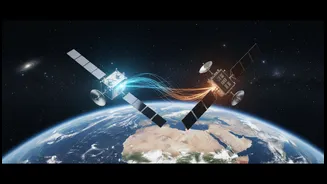
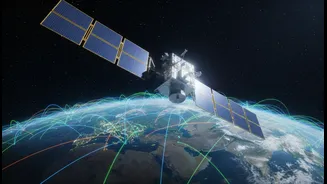
AI isn't just crunching numbers back on Earth; it's also making satellites themselves smarter. A concept called Dynamic Targeting allows an orbiting spacecraft to analyse its own data in real-time. For the first time, a satellite can look ahead, process imagery with onboard AI, and decide for itself where to point its instruments, all without human intervention. In recent tests, this entire process took less than 90 seconds. This could enable satellites to autonomously hunt for short-lived phenomena like volcanic eruptions or dodge clouds to get a clearer picture of the ground, ensuring that the data collected is of the highest possible value.
Accelerating Scientific Discovery
Beyond just processing images, AI is also helping scientists navigate the vast ocean of existing research. An IBM natural language processing model was trained on nearly 300,000 Earth science journal articles to help organise the literature and make discovering new knowledge easier. This accelerates the pace of research by helping connect findings across different studies. The ultimate goal, as stated by NASA officials, is to shrink the time between data collection and scientific understanding. By combining human expertise with AI's analytical power, the agency is not just observing our changing planet but is actively creating the tools needed to respond to its most urgent challenges.