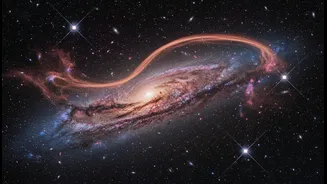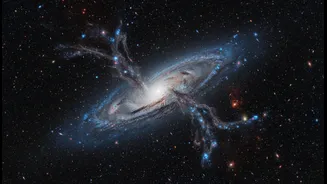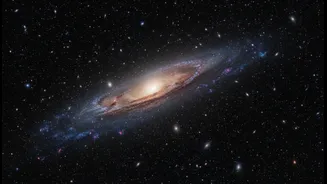






A Cosmic Crash in Unprecedented Detail
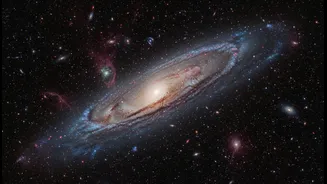
Located a relatively close 11 to 13 million light-years away, Centaurus A has long been a favourite target for astronomers. It’s one of the brightest objects in the southern night sky, but its most fascinating feature is its peculiar shape—the result
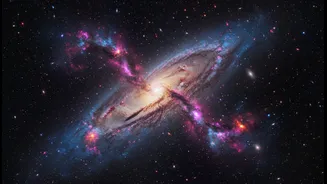
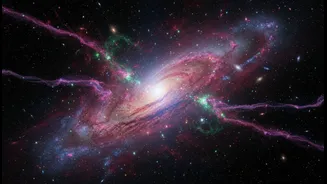
of a violent galactic merger. Around two billion years ago, a large elliptical galaxy collided with and consumed a smaller spiral galaxy. This cosmic crash left behind a dramatic band of dust and triggered furious bursts of star formation. While telescopes like Hubble and the now-retired Spitzer gave us tantalizing glimpses, their views were incomplete. Visible light couldn't pierce the thick dust lanes, and earlier infrared telescopes lacked the resolution to see fine details. Now, Webb’s powerful infrared vision has cut through the haze, transforming our understanding of this galactic battleground.
Galactic Archaeology, Star by Star
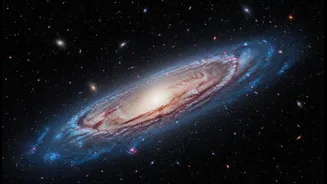
What previously looked like a hazy glow is now resolved into a densely packed tapestry of millions of individual stars. For the first time, scientists can perform what they call “galactic archaeology,” studying the galaxy star by star, even in its long-obscured central region. This high-resolution view allows them to build a precise timeline of the galaxy's evolution. By analysing the different generations of stars, they can reconstruct a history of the galaxy: identifying which stars existed before the collision, which were born during the cataclysmic merger, and which formed from the stirred-up gas in its aftermath. It’s like reading the rings of a cosmic tree, with each star holding a clue to the galaxy's violent and beautiful past.
A Supermassive Engine of Creation and Destruction
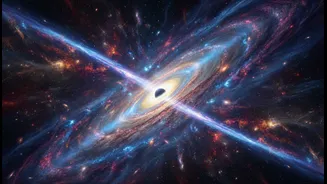
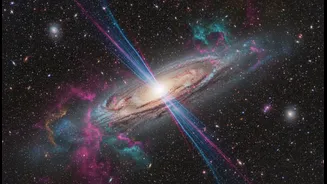
At the heart of Centaurus A lies an active supermassive black hole, an engine of immense power that is actively feeding on surrounding gas and dust. As it consumes this material, it launches powerful jets of energy and high-speed plasma far into space. Webb's instruments can do more than just take pictures; by analysing the light with spectroscopy, astronomers can measure the motion of gas within the galaxy. Early findings show fast-moving ionized gas being blasted outwards by the black hole's activity. This helps to answer one of astronomy's biggest questions: how does a black hole influence its entire host galaxy? The relationship appears to be complex. The black hole can trigger new star formation by compressing gas, but it can also stunt or “kill” star birth by violently blowing away the necessary raw materials. Centaurus A provides a rare, nearby laboratory to study this dual role in action.
The 'Next Step' for Astronomers
Webb’s new portrait of Centaurus A doesn't just answer old questions; it raises new ones, defining the “next step” in understanding galactic evolution. The image reveals intricate and surprising dust structures, including a strange, parallelogram-like band across the galaxy's core and a mysterious 'S' shaped feature that perplexes astronomers. What created these shapes? How does the black hole's activity influence them? Are they a direct result of the ancient merger? These new observations provide a rich dataset that will fuel years of research. By studying this nearby example of a galactic collision in such detail, scientists can build better models to understand similar, more distant events across the history of the universe. Each new discovery from Webb builds on the foundations of previous missions, creating a more complete picture of how galaxies grow and evolve.