


A Planet Identified by Its Shadow
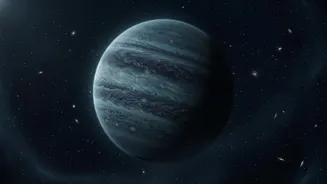
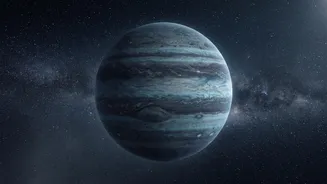
First, let's meet the main character. TOI-2535 b is a 'hot Jupiter', a massive gas giant orbiting its star at a blistering pace. Located about 1,000 light-years away, this planet completes a full orbit in just over eight days. For comparison, Mercury,
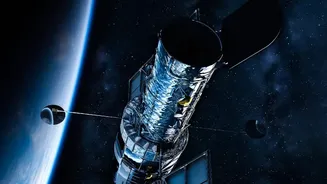
our own solar system's speediest planet, takes 88 days. The planet was first identified in 2019 by NASA's Transiting Exoplanet Survey Satellite (TESS). 'TOI' stands for 'TESS Object of Interest', a designation for candidate planets that require further observation to be confirmed. TESS doesn't see these planets directly; instead, it uses the 'transit method'. It stares at stars and waits for a tiny, periodic dip in their brightness, which indicates a planet is passing in front of it, casting a faint shadow our way.
The Case of the Vanishing Signal
For seven years, from 2019 to March 2026, astronomers watched the regular transits of TOI-2535 b. But they noticed something odd. The transits were becoming irregular, sometimes arriving up to six hours early or late. The duration of the dips in starlight also became shorter and fainter over time. Then, in March 2026, the signal vanished entirely. The planet simply stopped showing up in the data. This wasn't a case of a planet being destroyed. Instead, the very alignment that allowed us to see it in the first place had changed. The planet that was once crossing directly in front of its star from our viewpoint was now passing just above or below it, meaning its shadow no longer falls on Earth.
The Culprit: A Hidden Neighbor
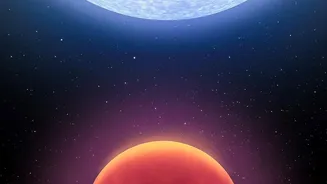
So, what caused this cosmic shift? The evidence points to a hidden companion. Researchers concluded that another large planet, likely at least the mass of Saturn, is also orbiting the star. The powerful gravitational pull between these two massive planets is causing their orbits to 'wobble' like spinning tops nudging each other. This interaction, known as orbital precession, is tilting TOI-2535 b's path from our perspective. The change was so rapid—happening over years instead of the expected millennia—that astronomers were able to watch the transit disappear in real time, a first for a planet orbiting a single star. This interaction is described by scientists as one of the most extreme and rapidly evolving orbital dynamics ever recorded.
What This Mystery Teaches Us
The story of TOI-2535 b is not a story of loss, but of discovery. It's a powerful reminder that solar systems are not static, clockwork mechanisms but dynamic, evolving environments. The gravitational dance between planets can change what we are able to see from our distant vantage point. This case highlights the limitations and challenges of the transit method, which relies on a lucky and often temporary alignment. A missing signal doesn't mean a missing planet. It also underscores the importance of long-term observation and the sophisticated technologies that allow us to detect not just the presence of a planet, but the subtle gravitational nudges from its unseen neighbours. This 'disappearance' actually confirmed the existence of a second planet in the system.