







What Are These ‘Smart’ Graders?
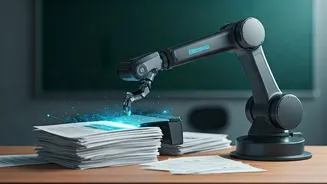
When we hear ‘grading devices,’ it’s easy to picture a futuristic robot marking papers. The reality is more software-based and varied. For objective tests, the technology is quite established. Think of Optical Mark Recognition (OMR) scanners that read
multiple-choice bubbles—a familiar sight in large-scale entrance exams. The 'smart' evolution here involves using a simple phone camera and an app to do the same job instantly, right in the classroom. For subjective answers, the technology becomes more complex. Here, we're talking about AI-powered platforms that analyse written text. These systems are trained on vast datasets of essays and answers, learning to identify keywords, sentence structure, argument coherence, and even grammatical accuracy. Instead of a single physical ‘device,’ teachers are adopting a suite of digital tools designed to automate what has always been a painstaking manual process.
The Undeniable Promise of Efficiency
The primary driver for adoption is time. In India, it's not uncommon for high school teachers to manage classes of 50, 60, or even more students. Grading one set of exams can consume weeks, eating into evenings and weekends. This is time that could be spent preparing more engaging lessons, providing one-on-one support to struggling students, or simply recovering from the demands of the day. Automatic grading tools promise to return this time. An OMR-based test for a class of 60 can be graded in minutes, not days. Even AI essay graders, while not perfect, can provide a first-pass assessment that significantly cuts down the teacher's workload. For educators drowning in paperwork, this isn't just a convenience; it's a lifeline that allows them to focus more on the core act of teaching and mentoring.
Beyond Speed: Data-Driven Insights
The 'smart' aspect of these tools goes beyond just speed. A key feature is the ability to generate instant, detailed analytics. After grading a test, the software can produce a report showing which questions the class struggled with the most, which concepts were widely misunderstood, and how individual students are performing over time. This is a paradigm shift from traditional grading. A human teacher might intuitively sense that the class found Section B difficult, but a smart system can prove it with data. It can show that 75% of students got question 7 wrong, which tests a specific algebraic concept. This allows the teacher to immediately address the learning gap with a targeted revision lesson, making instruction more responsive and effective. The focus moves from just assigning a score to actively diagnosing learning weaknesses.
The Human Element at Risk?
Herein lies the central debate. Can an algorithm truly appreciate the nuance of a well-crafted argument in a history essay, or the creative spark in a piece of literature analysis? Critics argue that over-reliance on automated tools, especially for subjective subjects, risks promoting a formulaic style of writing. Students may learn to write for the algorithm, prioritising keywords and predictable structures over genuine critical thinking and originality. Furthermore, a teacher's comments in the margins are more than just corrections; they are a form of dialogue. That encouraging note—'Good point!' or 'Expand on this idea'—is a vital part of the learning process. Automated feedback, while often detailed, can feel impersonal and may miss the deeper intent or a student's unique voice. The fear is that in gaining efficiency, we might lose a crucial aspect of human mentorship.
Fairness, Equity, and The Indian Context
The adoption of this technology is not uniform. These tools often come with subscription fees, raising concerns about equity. Will they create a new divide between well-funded private schools and under-resourced government schools? If a student in one school gets instant, detailed feedback from an AI, while another waits weeks for a manually graded paper, the learning gap could widen. There's also the question of bias. AI systems are trained on data, and if that data contains inherent biases, the AI will replicate them. An AI trained primarily on Western writing styles might unfairly penalise the unique phrasings and structures common in Indian English. For a country with such linguistic and cultural diversity, ensuring these tools are fair and context-aware is a monumental challenge that developers are still grappling with.