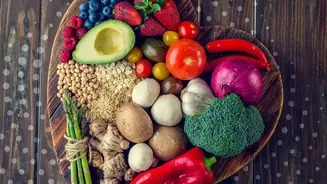








The Global Allure of 'Natural'
Across supermarkets worldwide, from Mumbai to Brussels, the 'natural' label is a powerful magnet for health-conscious shoppers. It taps into a desire for foods that are perceived as less processed and closer to their original state. Surveys have shown
that a majority of consumers actively seek out products with this claim, often believing it implies the food is free from GMOs, pesticides, and artificial ingredients. This 'health halo' effect makes it one of the most effective marketing tools in the food industry. However, the trust consumers place in the word often goes far beyond what regulations actually enforce, creating a significant gap between perception and reality.
A Term Without a Global Definition
The core of the confusion lies here: there is no single, legally-binding international standard for what constitutes a 'natural' food. This regulatory vacuum allows the term to be used in ways that can be ambiguous or even misleading. Unlike 'organic,' which is a strictly regulated and certified term in most countries, 'natural' is often left to the manufacturer's discretion. This lack of a clear, enforceable definition means that a product labeled 'natural' in one country might not qualify for the same claim in another, leaving consumers to navigate a complex and inconsistent landscape.
India: A Move Towards Clarity
In India, the Food Safety and Standards Authority of India (FSSAI) has provided specific guidelines to curb misleading claims. According to FSSAI regulations, a food can only be called 'natural' if it is a single-ingredient product derived from a plant, animal, or mineral source, has nothing added to it, and has only undergone minimal processing like washing, peeling, or drying that doesn't fundamentally alter it. This definition is quite clear: processed or multi-ingredient foods are not permitted to use the 'natural' label unless every single component qualifies individually. Despite this, consumers are often encouraged to be cautious, as 'natural' is not as rigorously audited as the 'Jaivik Bharat' logo for certified organic products.
The US: An Informal and Limited Policy
In the United States, the Food and Drug Administration (FDA) has no formal, binding definition for 'natural'. For decades, it has maintained a loose, informal policy stating that it does not object to the term if the food contains no added colour, artificial flavours, or synthetic substances. However, this guidance does not cover many of the things consumers associate with the term. For example, the FDA's policy does not address production methods like the use of pesticides, or manufacturing processes like pasteurisation. It also doesn't exclude ingredients derived from genetically modified organisms (GMOs) or the use of highly processed ingredients like high-fructose corn syrup.
The European Union: A Stricter Framework
The European Union generally has a more stringent approach to food labeling. While the term 'natural' itself isn't as tightly defined as specific nutrition and health claims, the EU's overarching laws prevent information that could mislead consumers. General principles state that a 'natural' claim is only appropriate for single-ingredient foods to which nothing has been added and which have undergone only minimal processing. Any claims about a food's nutritional or health benefits are strictly regulated under Regulation (EC) No 1924/2006, requiring scientific substantiation and approval from the European Food Safety Authority (EFSA). This means that while 'natural' can still be ambiguous, the broader regulatory environment offers consumers a higher degree of protection from unsubstantiated health halos.
How to Be a Smarter Shopper
Given the global inconsistencies, relying solely on the word 'natural' is not enough. To make truly informed choices, look past the front-of-pack buzzwords. First, always read the ingredients list. This is the most reliable source of information about what is in your food. Second, understand the difference between 'natural' and 'organic'. 'Organic' is a government-certified term that guarantees specific production standards, such as the absence of synthetic pesticides and GMOs. In India, look for the 'Jaivik Bharat' logo. Finally, be critical of vague marketing claims and look for specific, verifiable information rather than comforting but often meaningless words.