



The Perseid Meteor Shower
The absolute highlight of August is the Perseid meteor shower, one of the best and brightest of the year. It's active from mid-July to late August, but its peak is what you want to catch. This year is especially good because the peak, on the nights of August 12
and 13, coincides with a new moon. This means the skies will be exceptionally dark, making it easier to see the fainter meteors. Under ideal conditions, away from city lights, you could see up to 90 or 100 shooting stars per hour. The best viewing time in India is in the pre-dawn hours, from about 2:00 AM to 5:00 AM. Find a dark, open spot, lie back, and look towards the northeastern part of the sky. You don't need a telescope—the show is best enjoyed with just your eyes. These meteors are tiny debris particles left behind by Comet Swift-Tuttle.
A Pre-Dawn Parade of Planets
Mid-August offers a fantastic opportunity to see multiple planets line up in the pre-dawn sky. Around August 12 and 13, a rare alignment will make six planets visible, though with varying difficulty. Four of these—Saturn, Mars, Jupiter, and Mercury—can be spotted with the naked eye. The best time to look is about 30 to 60 minutes before your local sunrise. Face east and look for an arc of bright 'stars' stretching across the sky. Saturn will be a steady, yellowish point of light, while Mars will have a distinct reddish glow higher in the sky. Jupiter will be a very bright, silvery light, but it will be low on the eastern horizon, so you'll need a clear view. Mercury will be even lower and trickier to spot in the growing twilight. The other two, Uranus and Neptune, are too faint to see without binoculars or a telescope.
Say Hello to Saturn
While Saturn's big moment, its opposition, isn't until October, late August is an excellent time to start observing it. During August, the ringed planet will be visible for most of the night, rising in the evening and shining brightly. It will be one of the easiest 'stars' to spot in the planetary parade around mid-month. Even though its rings appeared to vanish in 2025 when they were edge-on to us, they are now tilting back toward Earth and are visible again in a small telescope. Look for a bright, yellowish, and steady point of light that doesn't twinkle like a star. This steady glow is a classic characteristic of a planet. It will be located in the constellation Pisces.
Spotting the Summer Triangle
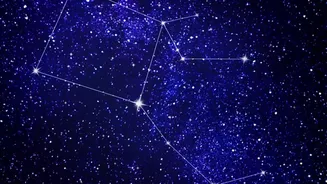
For those just starting out, constellations can feel daunting. A great entry point in the August sky is the Summer Triangle. It's not an official constellation but an 'asterism'—a prominent pattern of stars. It's made up of three of the brightest stars in the sky: Vega (in the constellation Lyra), Deneb (in Cygnus), and Altair (in Aquila). These will be high overhead during August evenings. They are so bright that you can often spot them even from light-polluted urban areas. Once you find the triangle, you can use it as a reference point to navigate to other, fainter constellations. The band of our own Milky Way galaxy runs right through the Summer Triangle, and if you are in a dark enough location, you can see this hazy, beautiful river of stars.
The Southern View: Scorpius and Sagittarius
Looking toward the southern horizon on an August evening, two prominent constellations command attention: Scorpius the Scorpion and Sagittarius the Archer. Scorpius is one of the few constellations that actually looks like its namesake, with a bright red star, Antares, marking its heart and a curved tail of stars sweeping down. To its left is Sagittarius, which many observers see as looking more like a teapot than an archer. This region of the sky is particularly special because it's where the dense, bright centre of our Milky Way galaxy is located. If you are under truly dark skies, away from the monsoon clouds, this area will appear thick with stars and faint nebulas. Even a pair of binoculars will reveal an astonishing number of star clusters and glowing gas clouds here.