


A Planet of Unexpected Geometry
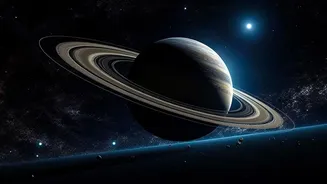
For decades, astronomers have been fascinated by a massive, six-sided jet stream at Saturn's north pole, known as 'the hexagon'. This remarkably stable feature, wider than planet Earth, has been a long-standing puzzle. Scientists had long searched for
a similar structure at the southern pole but found nothing, not even with the Cassini spacecraft that orbitered the planet for 13 years. That has now changed. Recent images from the Hubble Space Telescope, confirmed by a network of ground-based observers, have revealed a giant, 10-sided pattern, or decagon, emerging in the southern hemisphere. The discovery was a surprise, suggesting the conditions that create these giant polygons might be more common than previously thought.
What is This 10-Sided Wave?
Unlike a hurricane on Earth, this decagon isn't a single, contained storm. It's a massive wave embedded within one of Saturn's powerful jet streams, where winds can reach speeds of around 400 kilometres per hour. This wave pattern extends deep into the atmosphere, meaning it's not just a cloud-top phenomenon but a significant, vertically-structured feature. Unlike the long-lived northern hexagon, which has been stable for over 40 years, this new southern decagon appears to be a recent development. Analysis of Hubble data shows faint signs of it emerging in 2023, becoming much clearer in observations from 2024 and 2025. This gives scientists a rare opportunity to watch a giant atmospheric pattern develop in real-time.
What It Tells Scientists
The discovery of a second polygon tells scientists that the northern hexagon isn't a complete anomaly. It confirms that the physics of Saturn's atmosphere can naturally produce these strange geometric shapes at both poles. While the exact mechanism is still debated, leading theories involve the way jet streams and smaller vortices interact deep within the gas giant. Laboratory experiments have shown that rotating fluids can create polygons, but applying that to a planetary scale is complex. The appearance of a decagon, rather than another hexagon, suggests that subtle differences in conditions between the north and south poles lead to different outcomes. This finding provides a crucial new data point for computer models that aim to simulate the atmospheres of giant planets.
A Puzzle of Formation and Stability
One of the biggest questions is why the decagon has formed now. Its sudden appearance between 2017, when the Cassini mission ended, and 2023 is a major clue. Some researchers speculate it could be linked to Saturn's long seasons. The southern hemisphere is currently moving into its summer, which lasts over seven Earth years, and the increased sunlight could be influencing the atmospheric dynamics. Another clue may be a large, nearby storm or vortex that could be 'pinching' the jet stream and creating the wave-like pattern. The fact that the decagon appears to be evolving and strengthening makes it a prime target for future observation. Scientists will be watching closely to see if it stabilises into a long-lasting feature like its northern counterpart or if it's a more temporary phenomenon.