


The Sun's Dynamic Duo of Dangers
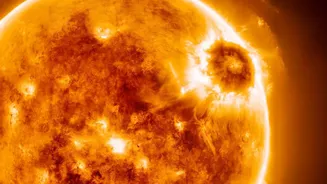
Before we dive into the 'how', let's quickly understand the 'what'. The Sun isn't just a calm, glowing orb. It actively releases huge amounts of energy and matter. One of the most powerful examples is a Coronal Mass Ejection (CME). This is a massive eruption
of solar plasma and magnetic fields from the Sun's outer atmosphere, the corona. These can travel at thousands of kilometres per hour. Then there's the solar wind, a continuous stream of charged particles flowing outwards from the Sun in all directions. Its speed, density, and temperature can change dramatically. Both CMEs and solar wind variations create what we call 'space weather', which can disrupt satellites, power grids, and communication systems on Earth.
A Perfect Perch in Space
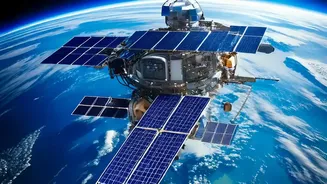
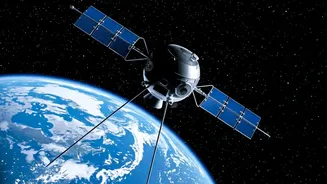
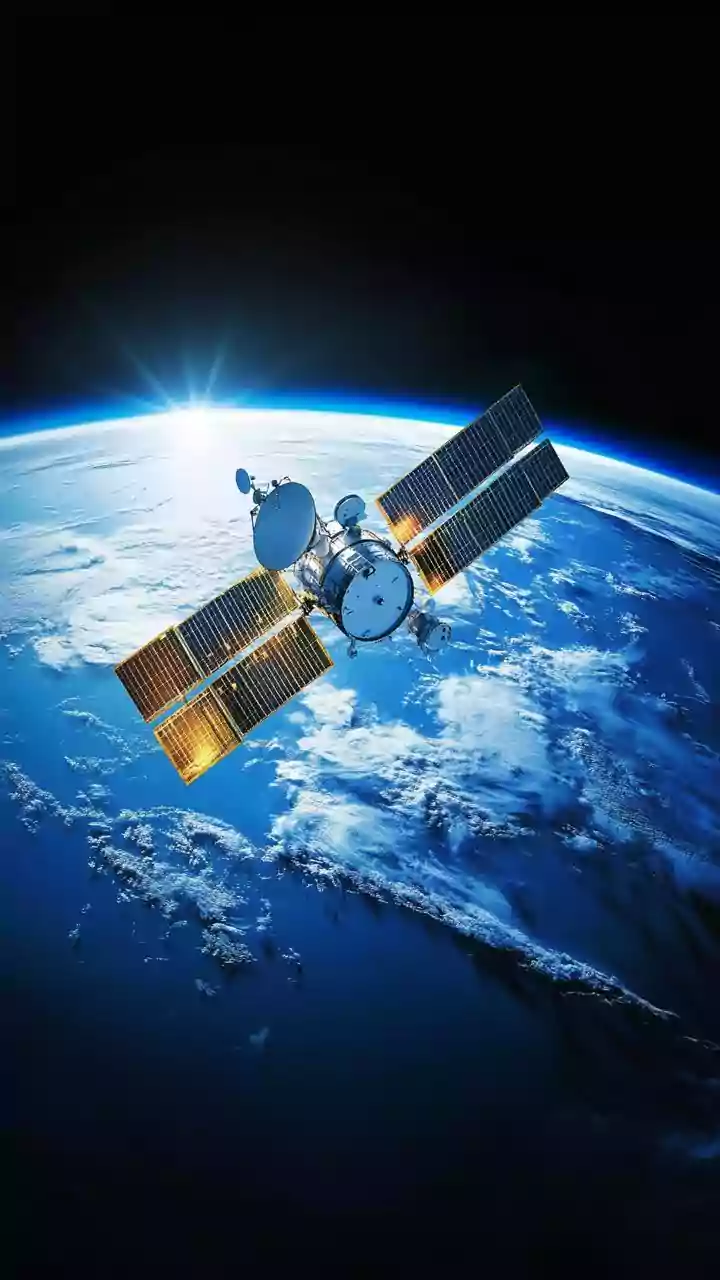
To watch these phenomena, you need a good seat. Aditya-L1 is positioned in a special spot 1.5 million kilometres from Earth, at a place called Lagrange Point 1 (L1). At L1, the gravitational pulls of the Sun and Earth balance out, allowing the spacecraft to maintain a stable position with minimal fuel. This gives it a continuous, uninterrupted view of the Sun, without any eclipses or occultations caused by the Earth or Moon getting in the way. This 24/7 solar surveillance is crucial for tracking the development and movement of CMEs and changes in the solar wind long before they reach our planet.
VELC: The CME Spotter
The primary instrument for watching CMEs as they leave the Sun is the Visible Emission Line Coronagraph (VELC). The Sun's main disk is so bright it completely washes out the much fainter corona. A coronagraph is a special telescope that creates an artificial eclipse, blocking the Sun’s bright face to make the corona visible. VELC is designed to do exactly this, allowing it to study the dynamics and origin of CMEs very close to the solar limb (the Sun's apparent edge). By capturing images and spectroscopic data, VELC can help scientists understand how these massive eruptions are initiated and accelerated. In fact, it has already captured the first-ever spectroscopic observations of a CME in visible light.
ASPEX and PAPA: Feeling the Solar Wind
While VELC watches events on the Sun, other instruments on Aditya-L1 directly sample the space environment around the spacecraft. These are the 'in-situ' instruments. Two key payloads for studying solar wind are the Aditya Solar wind Particle Experiment (ASPEX) and the Plasma Analyser Package for Aditya (PAPA). These instruments don't 'see' the wind but 'feel' it by measuring the particles that make it up. ASPEX uses two sensors, SWIS and STEPS, to measure solar wind ions like protons and alpha particles across a wide range of energies. Similarly, PAPA uses its sensors, SWEEP and SWICAR, to analyse the energy, composition, and direction of solar wind electrons and ions. Together, they provide detailed information on the speed, temperature, and density of the solar wind as it flows past the L1 point.
Putting It All Together with SUIT
Another crucial instrument is the Solar Ultraviolet Imaging Telescope (SUIT). It provides the bigger picture by capturing full-disk images of the Sun in the near-ultraviolet (NUV) spectrum. This allows scientists to see the lower and middle layers of the Sun's atmosphere—the photosphere and chromosphere—where the magnetic activity that drives CMEs and solar flares originates. By providing this context, SUIT's observations, combined with data from VELC and the in-situ instruments, help create a complete chain of observation. Scientists can see an event launch from the Sun's surface with SUIT, watch it expand through the corona with VELC, and then measure its properties directly with ASPEX and PAPA when it arrives at the spacecraft.
Why This Matters for India and Earth
This multi-instrument approach is what makes Aditya-L1 so powerful. It's not just about academic curiosity; it's about protecting our technology-dependent society. By understanding the origin and travel of CMEs and the behaviour of the solar wind, ISRO can contribute to more accurate space weather forecasting. An early warning of an incoming geomagnetic storm, triggered by a CME, could give satellite operators time to put their spacecraft in a safe mode and allow power grid managers to take protective measures. Aditya-L1's data provides India with a sovereign capability in this critical domain, enhancing global efforts to monitor the Sun and safeguard our future both in space and on the ground.