

Seeing the Invisible
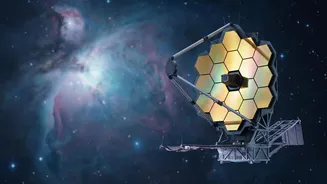
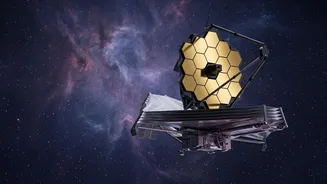
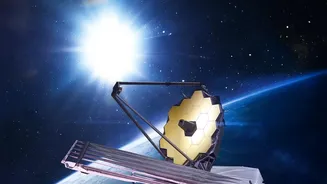
The JWST is designed to see the universe in infrared, a type of light that is invisible to the human eye. This is crucial for two reasons. Firstly, distant galaxies have their light stretched into infrared wavelengths as the universe expands, so seeing
in infrared is like looking back in time. Secondly, stars and planets form inside dense clouds of dust that visible light cannot penetrate. Infrared light, however, passes through this dust, giving astronomers a look inside these stellar nurseries. More importantly for finding water, molecules like water vapour happen to interact very strongly with specific wavelengths of infrared light. Earth's own atmosphere is so full of water that it blocks much of this light from reaching the ground, which is why a space-based telescope like Webb is essential for these observations.
The Science of Spectroscopy
To find water, astronomers use a technique called spectroscopy. In simple terms, this involves splitting light into its component colours, or wavelengths, creating a spectrum—much like a prism creates a rainbow. However, Webb’s scientific instruments, such as the Near-Infrared Spectrograph (NIRSpec) and Mid-Infrared Instrument (MIRI), are far more sophisticated. When starlight passes through the atmosphere of a planet, molecules in that atmosphere absorb very specific wavelengths of light. Each chemical, whether it's methane, carbon dioxide, or water, has a unique absorption 'fingerprint'. By looking at the starlight that has passed through a planet’s atmosphere, astronomers can see which wavelengths are missing. These missing slivers in the spectrum act like a chemical barcode, telling them exactly what the atmosphere is made of.
Hunting for Water's Fingerprint
Water vapour (H2O) has a well-known and very distinct fingerprint in the infrared spectrum. When astronomers point the JWST at a planet as it passes in front of its host star—an event called a 'transit'—they are performing what is known as transmission spectroscopy. They capture the light from the star before, during, and after the planet passes. By subtracting the normal starlight from the starlight that has been filtered through the planet’s atmosphere, they are left with only the absorption lines from the atmosphere itself. If they see the specific dips in light intensity that correspond to water's known absorption bands, they can confidently say they have detected water vapour. For example, Webb’s MIRI instrument has successfully detected the signature of water vapour in planet-forming disks, providing direct evidence of water’s availability in the earliest stages of a solar system’s life.
From Data to Discovery
The raw data from the JWST appears as graphs showing light intensity versus wavelength. For astronomers, a sharp dip at a wavelength like 6 microns is a tell-tale sign of water. However, interpretation requires careful work. Sometimes, a signal can be ambiguous. For instance, astronomers detected what appeared to be water vapour around the rocky exoplanet GJ 486 b, but they had to consider if the signature was coming from the planet's atmosphere or from cool, watery spots on the star itself. To resolve this, they often use multiple instruments (like NIRSpec and MIRI) and various analysis methods to confirm their findings. This cross-verification ensures that when a discovery is announced, such as the confirmed presence of water in the atmosphere of the gas giant WASP-96b, the scientific community can be certain of the result.