





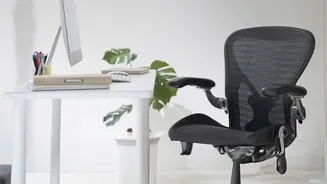
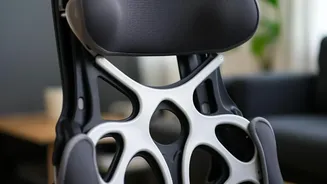
Start from the Ground Up: Seat Height
Everything about good posture starts with your feet. The height of your chair sets the foundation for your entire spinal alignment. To get it right, stand in front of your chair and adjust the seat until its highest point is just below your kneecap. Now,
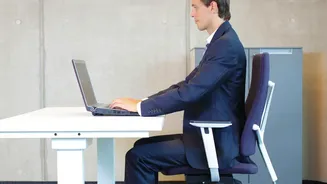
sit down. Your feet should rest flat on the floor, with your thighs roughly parallel to the ground. If your feet are dangling, the chair is too high; if your knees are pointing up towards the ceiling, it’s too low. Your knees should be at about a 90-degree angle, and there should be minimal pressure on the back of your thighs. If you have a desk that is too high to allow this, use a footrest to support your feet. This ensures your weight is properly distributed and not straining your lower back.
Fine-Tune Your Seat Depth
Seat depth is one of the most overlooked, yet critical, adjustments. If your seat is too deep, it will press against the back of your knees, cutting off circulation and forcing you to slide forward, losing all back support. If it’s too shallow, your thighs won’t be supported. The goal is to sit all the way back, so your lower back is touching the backrest. From there, adjust the seat depth so you can fit two to three fingers between the edge of the seat and the back of your knees. Most ergonomic chairs have a lever under the seat that allows you to slide the seat pan forward or backward to achieve this perfect fit.
Perfect Your Lumbar Support
Your spine has a natural inward curve in the lower back, known as the lumbar curve. The goal of lumbar support is to maintain this curve, preventing you from slouching and flattening your spine. Many ergonomic chairs have adjustable lumbar support. You should be able to move it up and down, and sometimes in and out (for depth). Adjust the height so the support fits comfortably into the natural curve of your lower back, which is typically around your belt line. Then, adjust the depth. The support should feel firm and fill the gap, but it shouldn't push you forward or create a feeling of excessive pressure. If it feels like a hard shelf in your back, you’ve gone too far.
Set the Right Backrest Angle
The idea that you must sit perfectly upright at a 90-degree angle all day is outdated. In fact, a slightly reclined posture of around 100 to 110 degrees can reduce pressure on your spinal discs. Most ergonomic chairs allow you to either lock the backrest at a certain angle or adjust the tension for a “free float” rocking motion. Set your backrest to a comfortable, slightly reclined angle that supports your upper body without making you feel like you are falling backward. This encourages what is known as dynamic sitting, where small movements throughout the day can relieve pressure.
Position Your Armrests Correctly
Armrests aren’t just for resting; they play an active role in reducing strain on your neck and shoulders. If they are too high, they will cause you to shrug your shoulders. If they are too low, you will lean to one side. The correct height is one that allows your arms to rest with your elbows at a 90 to 100-degree angle while your shoulders are relaxed and down. Your forearms should be parallel to the floor. If your chair has adjustable width or pivot functions, bring the armrests close enough to your body so your upper arms are near your torso, providing support without forcing you to reach outward.
Remember to Move
Even the most perfectly adjusted ergonomic chair cannot replace the need for movement. Your body is not designed to stay in one static position for eight hours. The best way to prevent stiffness and pain is to change your posture frequently. Set a reminder to get up, stretch, and walk around for a few minutes every hour. Even small shifts in your position, like rocking in your chair or doing gentle stretches at your desk, can promote blood circulation and relieve muscle tension, keeping back pain at bay.