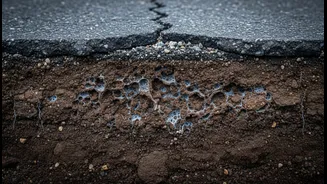









The Hidden Force Beneath Our Feet
Imagine pouring water into a bottle with only a narrow opening. If you pour too fast, the air inside has no time to escape and pushes back, slowing the water down. A similar phenomenon occurs in soil. The ground beneath us is not a solid block; it is a porous
matrix of mineral particles, organic matter, and countless tiny pockets of air. During a gentle rain, water seeps into these pores, and the air is slowly displaced. But during an intense, sudden downpour, water can seal the soil surface, trapping the air below. This trapped air becomes compressed, exerting an upward pressure that fights against the infiltrating water. This resistance can significantly reduce how much water the ground can absorb, turning potential soakage into dangerous surface runoff.
From Soil Science to Subterranean Tunnels
While soil scientists have long studied this effect on a small scale, new findings from an unexpected place have highlighted its power on a massive scale. Engineers at the Sanford Underground Research Facility (SURF), a deep subterranean laboratory in South Dakota, were puzzled when their complex ventilation systems would sometimes weaken or even reverse during heavy storms. After years of investigation, they discovered that massive volumes of rainwater being channelled down a deep shaft were acting like a giant piston, pushing a huge column of air through the tunnels with enough force to disrupt the entire airflow system. The discovery, reported in early July 2026, provided a dramatic, real-world example of how water and air interact underground, confirming that the weight of falling water can indeed move vast quantities of air.
Implications for Flooding and Infrastructure
This principle has profound implications for how we understand and predict flooding, especially in urban and agricultural areas. In cities, where much of the ground is covered by impermeable surfaces like concrete and asphalt, the remaining green spaces are critical for absorbing storm water. If trapped air pressure prevents these soils from taking in water effectively, runoff increases, overwhelming drainage systems and causing flash floods. Research shows that even small amounts of air pressure can reduce infiltration rates by an order of magnitude. This finding is crucial for civil engineers and urban planners, suggesting that flood models need to account for not just rainfall intensity and soil type, but also the dynamics of air pressure beneath the surface. The SURF findings also have direct relevance for the safety of mines and other underground facilities, where unexpected airflow changes during a storm could pose serious risks.
Rethinking Land and Water Management
Understanding the role of underground air encourages a more holistic approach to land management, particularly in a country like India where monsoon rains are becoming more intense. Practices that improve soil structure and prevent compaction are vital. Healthy, well-aerated soil with plenty of pathways for air to escape—created by roots, earthworms, and microorganisms—is less susceptible to air trapping. Techniques like conservation tillage in agriculture and the use of permeable pavements in cities can help maintain these pathways. For flood forecasters, incorporating data on pre-existing soil moisture and its potential for air entrapment can lead to more accurate warnings. Studies have shown that flood peaks can be two to four times higher when soils are already saturated, a condition that also makes air trapping more likely. This knowledge allows for better preparation, helping to protect property and lives.