



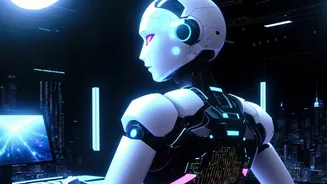

The Promise of a Digital Assistant
First, it's important to acknowledge what healthcare AI does remarkably well. In India, the AI healthcare market is growing rapidly, with expectations to reach significant figures by 2026. This investment is flowing into powerful tools that can analyse
medical images like X-rays with incredible accuracy, predict patient inflows at hospitals, and automate routine administrative tasks. For instance, major hospital chains are already using AI to handle patient documentation, aiming to free up hours of a doctor's day. These systems can process vast amounts of data, identifying patterns and potential health risks that might be missed by the human eye alone, effectively acting as a highly intelligent assistant. This enhances a doctor's ability, but it doesn't replace their core function.
The Irreplaceable Power of Empathy
Medicine is as much an art as it is a science, and its foundation lies in the human connection between doctor and patient. Clinical empathy—the ability to understand a patient's emotional state and perspective—is crucial for effective care. Patients are more likely to disclose vital information when they trust their physician, and this trust is built on empathic communication. While some studies show that AI chatbots can generate responses rated as highly empathetic, this is based on recognising and replicating patterns of empathetic language. It is not genuine curiosity or the shared human experience of vulnerability. An algorithm cannot truly sit with a patient's grief or fear; it can only process it as data. This human touch is vital for diagnosis, treatment adherence, and helping patients cope with difficult news.
Navigating Medicine's 'Grey Areas'
Not every medical case fits a perfect algorithm. Experienced doctors often rely on intuition and clinical judgment, skills developed over years of practice. They can read between the lines, noticing a patient's hesitation, a subtle physical sign not captured in a scan, or what a patient doesn't say. This ability to navigate uncertainty, incomplete information, and complex cases with multiple interacting factors is a hallmark of human expertise. AI systems are trained on existing data, and if that data is biased or incomplete, the AI's conclusions can be flawed or even harmful, potentially worsening existing health disparities. A human doctor can apply critical thinking and draw on a broad base of experience to question the data and make a judgment call, a feat that remains a significant challenge for AI.
The Burden of Final Responsibility
One of the most significant hurdles for replacing doctors with AI is the question of accountability. When a human doctor makes a diagnosis or recommends a treatment, they are legally and ethically responsible for that decision. If an AI system makes an error leading to misdiagnosis or harm, who is at fault? Is it the hospital that used the software, the developers who created the algorithm, or the doctor who may have simply approved the AI's conclusion? The decision-making process of many AI models is a 'black box,' making it difficult to understand how a conclusion was reached. This lack of transparency raises major ethical and legal issues that the healthcare industry is still grappling with, making the idea of a fully autonomous AI physician a distant and complicated prospect.
A Future Built on Collaboration
The most likely future is not one of replacement, but of collaboration. The consensus among many medical professionals is that AI will become an indispensable tool that augments, rather than replaces, human doctors. Think of AI as the most advanced stethoscope ever created—a tool that provides unprecedented insight but still requires a skilled professional to interpret its findings and apply them to the unique context of a patient. AI can handle the data-heavy lifting, freeing doctors from administrative burdens and allowing them more time to focus on what they do best: communicating with patients, building trust, and exercising nuanced clinical judgment. Physicians who learn to effectively use AI will be empowered to provide better care, but the core of medicine will remain profoundly human.