








What Are Cosmic Lighthouses?
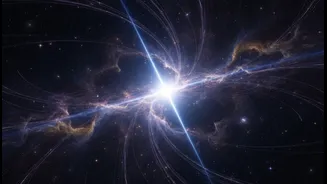
Pulsars are a type of neutron star, the incredibly dense, city-sized remnants of massive stars that have exploded. They are nature's ultimate physics laboratories, packing more mass than our sun into a tiny, spinning sphere. What makes them 'lighthouses'
is their rapid rotation combined with powerful magnetic fields, which are trillions of times stronger than Earth's. These fields create beams of radiation that shoot out from the pulsar's magnetic poles. As the star spins, these beams sweep across the cosmos. If one of these beams happens to cross our line of sight on Earth, we observe a regular 'pulse' of radiation, much like a sailor seeing the beam of a lighthouse.
From Pulses to a 'Map'
The headline's "Lighthouse Pulsar Map" isn't a single chart on a wall, but a method of study. Recent breakthroughs involve NASA’s Imaging X-ray Polarimetry Explorer, or IXPE. For the first time, scientists have used IXPE to directly measure the magnetic properties of a pulsar and its surrounding nebula, specifically one nicknamed the 'Lighthouse Nebula'. By observing the X-rays coming from these objects, IXPE can measure the light's polarization—a property that describes the direction of its electric field vibrations. This measurement acts as a compass, revealing the direction and structure of the magnetic fields that the light has travelled through. It confirms theories that particles escaping from pulsars flow along the galaxy's magnetic field lines.
The Magnetic Field Connection
Magnetic fields are invisible but crucial forces that shape the structure of nebulae, stars, and entire galaxies. Studying them is notoriously difficult. This is where pulsars and instruments like IXPE come in. As the X-rays from a pulsar travel through space, their polarization is affected by the magnetic fields they encounter. By analyzing the changes in polarization, scientists can infer the properties of these fields. A recent study of the Lighthouse Nebula, led by a Stanford University undergraduate, did exactly that. The observations confirmed with more than 99% confidence that the magnetic field in a long filament extending from the pulsar aligns with the flow of particles, validating a long-held theory.
A Sharper, More Complex Picture
This new technique doesn't just confirm old ideas; it adds surprising new layers of complexity. For instance, observations of the Lighthouse Nebula revealed that the magnetic field orientation seen in X-rays was strikingly different from that observed in radio waves. This suggests that particles of different energies are influenced by distinct magnetic structures within the same system, hinting at multiple acceleration mechanisms at play. Far from a simple 'bar magnet' model, pulsar magnetic fields are proving to be much more complicated. Instruments like NASA's NICER, aboard the International Space Station, have also contributed by creating the first surface maps of pulsars, revealing complex patterns of 'hot spots' that defy simple models.
Grounded Expectations: The Reality of the Research
The phrase 'without cosmic overstatement' is crucial here. This method is a powerful new tool, but not a magic wand. The work is painstaking. The X-ray signals from the Lighthouse Nebula, for example, are relatively faint. Scientists at NASA had to develop advanced analysis methods just to squeeze every bit of information from the data collected over nearly 18 days of observation in June 2025. Furthermore, the findings often raise as many questions as they answer, such as the divergence between X-ray and radio magnetic field data. It shows that even with a better map, the territory of cosmic magnetism is more intricate and turbulent than previously imagined. This isn't a final answer, but a significant improvement in our ability to ask the right questions and gather specific data from these extreme environments.