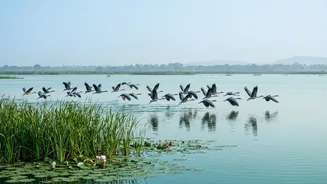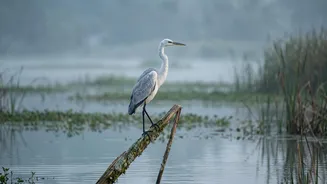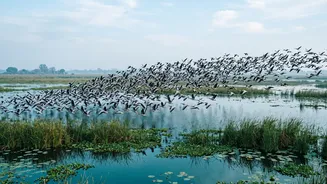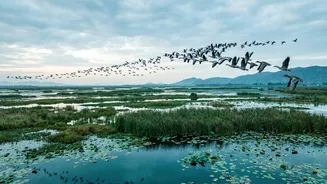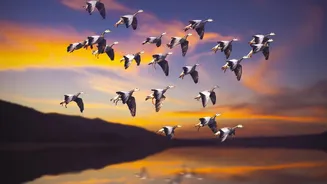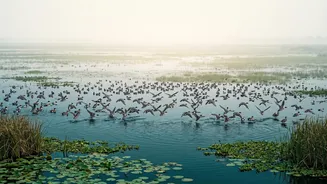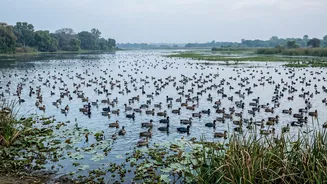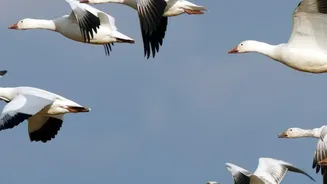






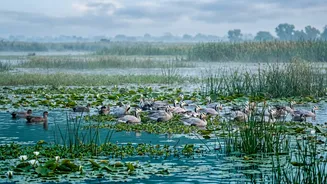

Each winter, India's wetlands transform into a spectacular theatre of life as millions of migratory birds arrive. But their journey is not just guided by an ancient instinct; it's a precise dance choreographed by a powerful, local partner: water.
A Banquet Prepared by the Monsoon
For migratory
birds travelling thousands of kilometres from Siberia, Central Asia, and Europe, India's wetlands are not just a winter home but a critical refuelling station. The journey is incredibly energy-intensive, and their survival depends on finding abundant food upon arrival. This is where the monsoon plays a pivotal role. The seasonal rains, which sweep across the subcontinent from June to September, replenish the lakes, marshes, and rivers that will host these winged visitors. This infusion of fresh water triggers a boom in the aquatic food chain. Fish populations flourish, insects hatch in vast numbers, and aquatic vegetation thrives, creating a veritable banquet for the arriving flocks. A healthy monsoon essentially sets the table for the millions of ducks, geese, waders, and cranes that rely on these ecosystems.
The 'Goldilocks' Principle of Water Levels
The success of a migratory season hinges on a delicate balance of water. It's not just about having water, but about having the right amount at the right time. If a region suffers from a drought or poor rainfall, wetlands can shrink or dry up completely. This leads to a collapse in food sources, and birds may either bypass the area entirely or arrive to find a barren landscape. For example, deficient rainfall at the Hokersar wetland in Kashmir and the Najafgarh wetland near Delhi in recent years has raised concerns about their ability to support incoming bird populations. Conversely, excessive rainfall or flooding can be just as detrimental. Water that is too deep can submerge the shallow mudflats where wading birds feed and drown the submerged vegetation that ducks and geese rely on. The ideal condition is a mosaic of shallow and deep water zones, which supports the widest variety of species.
A Tale of Two Wetlands
The impact of water levels is clearly visible in some of India’s most famous bird sanctuaries. Keoladeo National Park in Bharatpur, Rajasthan, is a man-made wetland that is heavily dependent on a managed water supply. In years of water scarcity, the park struggles to attract its usual numbers of birds, affecting not just wildlife but also the local tourism economy. Park authorities often have to arrange for water to be channelled from nearby rivers to maintain the habitat. In contrast, a year of abundant rainfall can lead to spectacular results. At Sambhar Lake, also in Rajasthan, record-high water levels in recent years have been directly linked to a significant surge in the numbers of migratory flamingos and other species. Similarly, consistent monitoring and management of water levels and habitat at Chilika Lake in Odisha, Asia’s largest brackish water lagoon, have contributed to a steady rise in bird counts, with over 1.1 million birds recorded in early 2026.
An Increasingly Unpredictable Future
While the relationship between water and birds is ancient, it is now being disrupted by climate change. Erratic monsoon patterns, rising temperatures, and more frequent extreme weather events are making conditions unpredictable for migratory birds. Scientists have noted that some species are arriving earlier or later than usual, a shift that can create a dangerous mismatch between their arrival and the peak availability of food. For example, a delayed monsoon can mean a delayed bloom in food resources, leaving early arriving birds hungry. Long distance migrants are particularly vulnerable to these changes, as their journeys are timed to coincide with specific seasonal cues across multiple continents. The challenges of habitat loss and pollution further compound the problem, putting these incredible annual journeys at risk.