


Catch the Next Meteor Showers
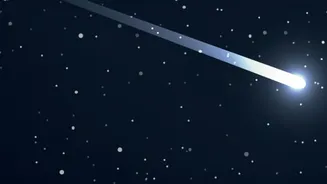
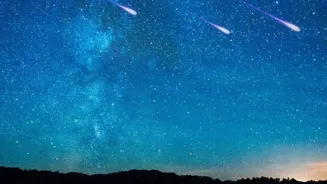
While the Perseids are famous for their high rate of bright meteors, they aren't the only shower on the calendar. As autumn approaches, a few other opportunities to see shooting stars arise. First up are the Draconids, which peak on the evening of October
7th or 8th, 2026. This is a minor shower, typically producing only about 10 meteors per hour, but it has a unique advantage: the best viewing time is in the early evening, right after dark, making it more convenient for many observers. Later in the month, look for the Orionids, which peak on the night of October 21-22. These meteors are fragments of Halley's Comet and can produce up to 20 meteors per hour in a dark sky. For the 2026 Orionids, the Moon will set after midnight, providing dark skies for the best viewing in the early morning hours.
Say Hello to the Planets
Late summer and autumn offer a fantastic planetary lineup. Throughout August and September 2026, the brilliant planet Venus will be a dazzling beacon low in the western sky after sunset. Meanwhile, Saturn will be putting on a great show. The ringed planet rises earlier each evening through August and September, and on October 4, it reaches opposition. This is when Saturn is directly opposite the Sun in our sky, making it visible all night long and appearing at its brightest and best for the year. Mars will also be a prominent target, growing brighter in the pre-dawn eastern sky. And for those with binoculars and a bit of patience, Uranus will be at opposition on November 25, appearing as a tiny blue-green dot.
Gaze into the Heart of the Milky Way
While often associated with summer, the core of our own galaxy, the Milky Way, remains a stunning sight into the early autumn. The famous Summer Triangle asterism, made up of the bright stars Vega, Deneb, and Altair, is your guide. This pattern remains high in the sky during early autumn evenings. The Milky Way runs right through it, with the star Deneb located in the middle of this river of stars. To see it, you'll need to get away from city lights to a truly dark location. Let your eyes adapt for at least 20 minutes and look for a faint, glowing band stretching across the sky. What you're seeing is the combined light of billions of distant stars in our galaxy's spiral arms.
Find a Whole New Galaxy
One of the most awe-inspiring objects you can see is not in our galaxy at all. The Andromeda Galaxy, also known as M31, is the closest major galaxy to our own, located about 2.5 million light-years away. Autumn is the best time to see it, as it rises higher in the sky. From a dark location, it is visible to the naked eye as a faint, fuzzy patch of light. To find it, use the W-shaped constellation Cassiopeia as a pointer. The deeper V-shape of the 'W' acts like an arrow pointing toward Andromeda. Binoculars will provide a much better view, revealing its elongated, oval shape. While you won't see the spiral arms visible in photographs, the faint glow is the light from hundreds of billions of stars that has traveled for millions of years to reach your eyes.
Learn the Autumn Constellations
As the summer constellations shift west, a new set of star patterns takes centre stage. The Great Square of Pegasus is one of the most prominent signposts of the autumn sky. This large, nearly perfect square of four stars is easy to spot. Branching off from one corner of the square is the constellation Andromeda. Nearby, you'll find the distinctive 'W' of Cassiopeia, which is circumpolar from mid-northern latitudes, meaning it never sets below the horizon. These patterns provide new anchors for exploring the night sky and serve as helpful guides for finding fainter objects. Using a stargazing app on your phone (with a red-light filter to preserve your night vision) can be a great way to learn their names and shapes.