


A Sweet Steeped in History
The story of Tirunelveli Halwa is as rich as its flavour. While wheat-based halwas travelled across India over centuries, this specific version has roots in the 19th century. History credits Jegan Singh with commercializing the sweet in 1882, establishing
the first shop and moving the delicacy from private kitchens to the public. This made the halwa accessible to everyone, cementing its place in the region's culinary identity. Perhaps the most famous purveyor is the 'Iruttu Kadai' (literally, 'Dark Shop'), a humble, decades-old establishment near the Nellaiappar Temple that traditionally sold its much-sought-after halwa for only a few hours each evening under the light of a single lantern. This minimalist approach only added to its mystique, proving that true quality needs no elaborate branding.
The Secret in the Water
What makes Tirunelveli Halwa impossible to perfectly replicate elsewhere? Many believe the answer flows in the Thamirabarani River. This perennial river, originating in the Western Ghats, is the lifeblood of the Tirunelveli region. Locals have long held that its water, enriched by the herbs and flora of the hills it passes through, possesses a unique mineral composition. This special water is considered a crucial ingredient, lending the halwa a distinctive taste and texture that cannot be achieved with any other water source. It’s a powerful reminder of how regional cuisine is intrinsically linked to its geography, where even the water tells a story of place.
A Labour of Love and Patience
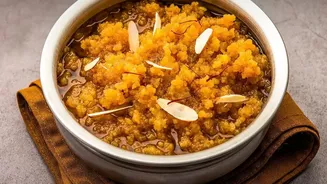
The creation of Tirunelveli Halwa is an art form defined by patience. The process is laborious and cannot be rushed. It begins with soaking whole samba wheat grains, often overnight, then grinding them to extract a thick milk. This wheat milk is then cooked in a large cauldron with sugar and generous amounts of ghee. The most critical part is the constant, slow stirring over a consistent flame for hours. This meticulous process, known as 'kinduthal', prevents lumps and gradually transforms the mixture. As it cooks, the halwa thickens, darkens to its signature caramel brown, and develops a glossy sheen. The final sign of perfection is when the halwa begins to leave the sides of the pan and the ghee separates, a testament to the skill and dedication of the artisans who make it.
An Edible Link to Heritage
Tirunelveli Halwa is not alone in its role as a custodian of culinary heritage. Tamil Nadu is home to several other sweets whose identities are tied to specific places and traditional methods. Consider the Srivilliputhur Palkova, a simple yet sublime sweet made from just high-quality local cow's milk and sugar. The unique quality of the milk, derived from cows grazing on specific local fodder, and the slow-boiling technique give it a flavour so distinct it has earned a Geographical Indication (GI) tag. Similarly, the Kovilpatti Kadalai Mittai, a crunchy peanut and jaggery brittle, gets its signature taste from the use of special Theni jaggery and water from the Thamirabarani River, linking it back to the region's natural resources. This too is protected by a GI tag, legally recognizing its unique origin.