





Start With Your Posture
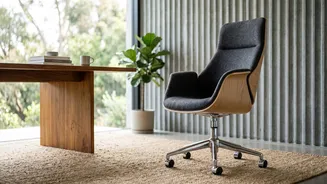
Before you stretch a single muscle, check your seated position. Many aches stem from prolonged poor posture. Aim for the '90-90-90' rule: knees bent at a 90-degree angle with feet flat on the floor, hips at a 90-degree angle, and elbows bent at a 90-degree angle as
your hands rest on your keyboard. Your lower back should be supported by the chair's lumbar cushion, and you should be sitting all the way back, not perched on the edge. Your monitor should be at eye level to prevent your head from tilting down, a major cause of 'tech neck'. Taking a moment to correct your posture is the first and most fundamental step toward all-day comfort.
Gentle Neck Stretches for Immediate Relief
Neck strain often comes from holding your head in a fixed position for too long. Incorporating simple, gentle stretches every hour can significantly reduce tension. Try a side neck stretch: while sitting tall, slowly tilt your head toward your right shoulder, holding for 15-20 seconds to feel a light stretch along the left side. Repeat on the other side. Follow this with a chin tuck. Sit straight and gently guide your chin backward as if you are making a double chin, holding for a few seconds. This helps realign the head over the shoulders, counteracting the forward-head posture common in desk work.
Release Your Upper Back and Shoulders
The muscles between your shoulder blades often bear the brunt of hunching. A simple shoulder shrug and roll can work wonders. Inhale and lift your shoulders up toward your ears, hold for two seconds, and then exhale as you let them drop completely. Follow this by rolling your shoulders up, back, and down in a smooth circle a few times to release tension. Another effective exercise is the shoulder blade squeeze. Sit upright and imagine you are trying to hold a pencil between your shoulder blades. Squeeze them together and hold for 5-10 seconds, then release. Repeat this several times to activate and relieve these overworked muscles.
Mobilize Your Thoracic Spine
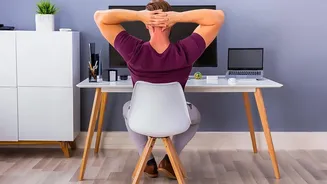
Your thoracic spine—the upper and middle part of your back—can become stiff from prolonged sitting, leading to a rounded posture. A chair-based thoracic extension can help counteract this. Sit upright in a sturdy chair and place your hands behind your head. Keeping your lower back stable, gently lean your upper back over the backrest of your chair, looking forward or slightly upward. Breathe deeply and hold this gentle arch for about 20-30 seconds. This movement encourages extension in the upper back, relieving the pressure that builds from hunching forward.
Try a Seated Spinal Twist
Rotation is a key movement for a healthy spine that often gets neglected during the workday. A seated spinal twist can help improve mobility and ease stiffness. Sit tall at the edge of your chair with your feet flat on the floor. Inhale to lengthen your spine. As you exhale, gently twist your torso to the left, placing your right hand on your left knee for a light leverage. Hold the twist for a few breaths, feeling the stretch through your mid-back. Return to the center and repeat on the right side. The key is to initiate the movement from your mid-back, not your hips or neck.
The Power of Regular Movement
While these chair-based exercises are incredibly beneficial, the most effective long-term strategy is to avoid prolonged static postures altogether. Your body is designed to move. Set a timer to remind yourself to stand up, stretch, and walk around for a few minutes every hour. Even a short break to grab a glass of water or walk to a colleague's desk can reset your posture and prevent the stiffness from setting in. Consistent movement is more effective than any single stretch. Integrating these small breaks into your daily routine is the best preventative medicine for workplace aches and pains.