




The Quantum Threat to Digital Security
For decades, our digital world has been secured by mathematical problems so complex that even the fastest supercomputers would take billions of years to solve them. This is the basis of modern encryption, the invisible shield protecting everything from
your email to military communications. But the era of quantum computing is dawning, and it changes the rules entirely. These powerful new machines are designed to solve exactly these kinds of complex problems with astonishing speed. When they become powerful enough, a moment many experts see on the horizon, they will be able to crack today's encryption standards, rendering nearly all of our secured data vulnerable. This isn't just a technical upgrade; it's a fundamental threat to global security, finance, and privacy.
Quantum Key Distribution: The Unhackable Fix
So, how do you defend against a quantum attack? The answer may be to use quantum mechanics itself. The leading solution is called Quantum Key Distribution (QKD). Think of it less like a stronger password and more like magic ink. In a QKD system, a secret key—a string of random bits used to encrypt and decrypt data—is sent via individual particles of light called photons. According to the laws of quantum physics, the very act of observing a photon unavoidably changes it. This means if an eavesdropper tries to intercept the key while it's being transmitted, they will leave behind undeniable evidence of their snooping. The legitimate users will see the disturbance, discard the compromised key, and generate a new one. This makes the key exchange process provably secure, not because of a hard math problem, but because of fundamental physics.
Inside India's National Quantum Mission
Recognizing the strategic importance of this technology, India launched its National Quantum Mission (NQM) in 2023. Backed by over $700 million in funding, the mission is a sweeping effort to establish the country as a global leader in all facets of quantum technology, from computing and sensing to materials science. A central pillar of the NQM is the development of a robust, nationwide secure communication network using indigenous QKD technology. One of its flagship goals is to establish inter-city quantum communication over 2,000 kilometers. The mission is already showing rapid progress, having recently demonstrated a 1,000-kilometer secure link—a major milestone achieved far ahead of schedule. This progress, driven by a mix of government labs, research institutions, and supported startups, signals India's serious intent to build its own quantum-secure infrastructure.
The Satellite Bridge Between Ground Stations
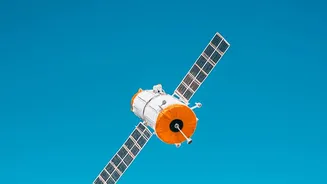
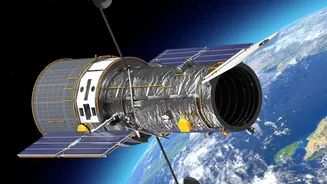
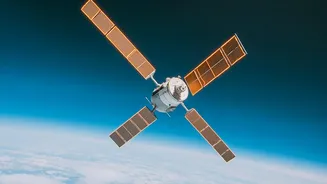
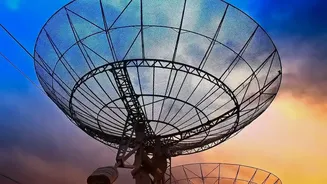
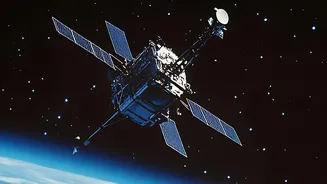
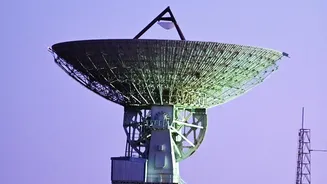
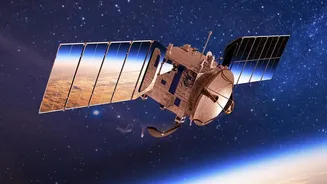
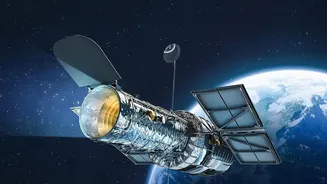
While QKD works well over dedicated fiber optic cables, it has a distance problem. Over long stretches, the signal carrying the delicate photons degrades, limiting a single secure link to a few hundred kilometers. This is where the headline's 'ground stations' come in. To create a truly national or global network, you need to go beyond terrestrial fiber. The NQM's solution is to use satellites as trusted nodes in space. A satellite can generate a quantum key and securely transmit it down to a ground station in one location. It can then do the same for another ground station thousands of kilometers away, effectively acting as a bridge. This satellite-based QKD bypasses the distance limitations of fiber and is critical for securing communications between distant military bases, diplomatic missions, and critical infrastructure nodes across a country as vast as India. The Indian Space Research Organisation (ISRO) is actively developing the capability to demonstrate this over a range of 2,000 kilometers.
A New Player in a High-Stakes Global Game
India's push into quantum communication is not happening in a vacuum. It is part of a global technology race with profound geopolitical implications. China has already made significant strides, launching its own quantum satellite, Micius, years ago and establishing the world's largest QKD network. The United States and European nations are also investing billions in their own quantum initiatives. By developing its own sovereign capability, India aims to reduce its dependence on foreign technology for national security and position itself as a key technological power. For the U.S. and its allies, India's rise as a quantum player offers the potential for partnership in setting global standards and creating a strategic counterweight in this critical technological domain. This isn't just about building a new network; it's about shaping the future of secure global communication.