





The Allure of Hidden Oceans
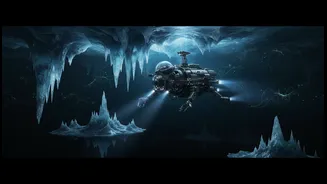
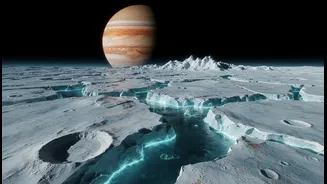
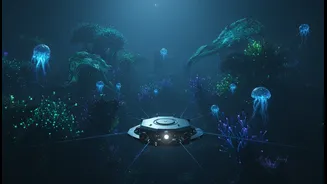
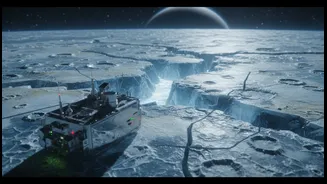
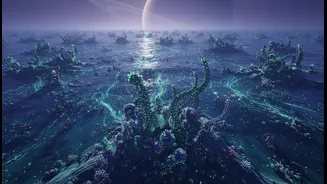
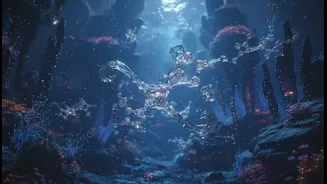
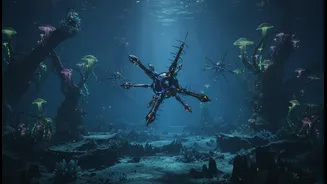
For decades, the mantra for finding life beyond Earth has been to "follow the water." This has led scientists to the icy moons of our outer solar system. Worlds like Jupiter’s Europa and Saturn’s Enceladus are believed to harbour vast, global oceans of liquid
water beneath their frozen crusts. These are not just cold, dark seas; they have potential energy sources from the gravitational pull of their giant parent planets, a process known as tidal heating. This energy could fuel chemical reactions on the seafloor, potentially providing the necessary ingredients and conditions for life to emerge and survive. With evidence of water, energy, and chemicals, these ocean worlds are currently the most promising candidates in our solar system for hosting life as we don't know it.
The Problem of 'Fool's Gold'
Finding life isn’t as simple as pointing a detector at a sample and getting a 'yes' or 'no' answer. The biggest challenge in astrobiology is the problem of false positives. Nature is a clever chemist, and many non-biological geological and chemical processes can create molecules or patterns that mimic what life might produce. These are the astrobiologist’s equivalent of fool’s gold. For instance, finding methane in an atmosphere could be a sign of biological activity, or it could simply be the result of geological processes. A single 'biosignature' is no longer considered sufficient proof. Announcing the discovery of alien life based on a signal that turns out to be abiotic would be a major setback for the field, so the scientific community is raising the standard of evidence.
Raising the Bar for Proof
In response to this challenge, the astrobiology community, with guidance from organisations like NASA, is establishing a much stricter set of rules. This isn't about one new test but a whole new framework for how to report evidence. The key principle is that a single discovery is not enough; scientists must build a case with multiple, independent lines of evidence. NASA has even conceptualised a framework called the 'Confidence of Life Detection' (CoLD) scale, which outlines how to progressively build confidence in a discovery and communicate it responsibly. This approach requires deep context, demanding that scientists rule out all possible non-biological explanations for what they're seeing before even beginning to consider life as an answer. This marks a major shift from a search for a single smoking gun to the careful construction of a detailed, verifiable scientific argument.
What This Means for Future Missions
This new-found rigour directly impacts how we plan and interpret missions. The upcoming Europa Clipper mission, for example, is not designed to find life directly but to investigate Europa’s habitability—itself a critical step on the new 'ladder of life detection.' Should it detect complex organic molecules in the plumes erupting from Europa's surface, scientists will have to go through an exhaustive process to prove those molecules could not have been formed without biology. Recent experiments suggest that some biosignatures like amino acids could survive near the surface, meaning a future lander might not have to drill kilometres deep. However, any sample it collects will be subjected to this intense new level of scrutiny. The goal is to ensure that when a discovery is announced, it is built on a foundation of undeniable, cross-verified evidence.
A Lesson in Scientific Humility
For students of space missions and aspiring astrobiologists, this evolution offers a profound lesson. The romantic notion of a lone scientist having a sudden 'eureka!' moment is being replaced by the reality of collaborative, painstaking, and deeply skeptical science. The key takeaway is that in the quest for something as extraordinary as alien life, the most important tools are not just advanced sensors, but also patience, rigour, and a disciplined process for questioning every result. It teaches that the burden of proof must be exceptionally high. This disciplined approach ensures that science moves forward on solid ground, especially when tackling questions that could change our world forever.