




The Growing Junkyard Above Our Heads
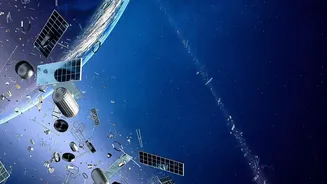
Imagine a highway with no rules, where cars that break down are simply abandoned to coast forever, posing a risk to every other vehicle. That is the situation in low Earth orbit. For decades, we have been launching satellites, but with no robust plan
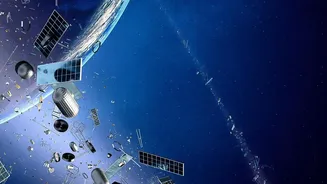
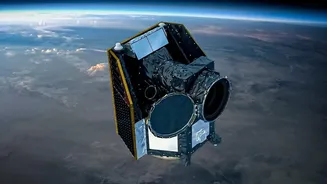
for their disposal. The result is a cloud of 'space junk'—inactive satellites, spent rocket stages, and millions of smaller fragments from collisions and explosions. According to space agencies, there are tens of thousands of large, trackable objects, and millions more that are too small to monitor but still dangerous. These objects travel at speeds over 25,000 km/h, turning a defunct satellite into a potential bullet that can destroy active, multi-million dollar spacecraft responsible for communication, navigation, and scientific research. This creates a cascade effect, known as the Kessler Syndrome, where one collision generates debris that leads to more collisions, threatening to make certain orbits unusable.
Why Is Cleanup So Hard?
Retrieving a dead satellite is not like towing a car. These objects are often tumbling unpredictably through space. A satellite that has lost power cannot maintain its orientation, and small forces can cause it to start spinning chaotically. Trying to grab a tumbling, multi-ton object with a robotic arm or net is incredibly risky. A miscalculation could damage the cleanup craft, break the target into more pieces, and make the problem worse. Furthermore, many older satellites were not designed to be captured; they have no convenient handles or grappling points, and their fragile solar panels or antennas can easily break off. The sheer cost and technical complexity of these active debris removal (ADR) missions have been major barriers to a large-scale cleanup effort.
An Elegant Solution: The Magnetic Touch
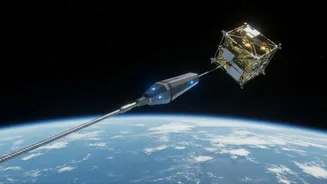
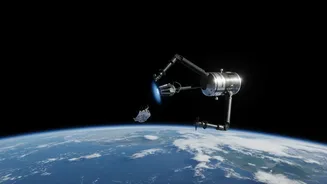
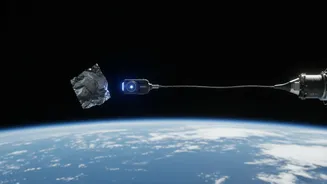
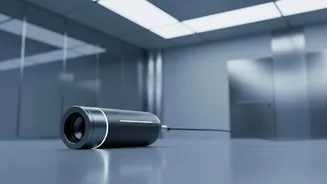
This is where magnetic capture probes offer a revolutionary alternative. Instead of a high-risk physical grab, these systems use powerful electromagnets to interact with the target from a short distance. A 'chaser' satellite equipped with a magnetic probe approaches the debris. The key is a phenomenon called eddy currents. Even if the target satellite isn't magnetic itself (many are made of aluminum), a changing magnetic field from the probe induces electrical currents within the debris's conductive body. These eddy currents create their own magnetic field, allowing the chaser probe to exert a gentle force—a push or a pull—without ever making physical contact. This non-contact approach can first be used to slow and stabilize a tumbling object, making it safe to approach. Once stabilized, the magnetic force can be used to establish a firm, reliable grip for towing the debris out of orbit.
From Concept to In-Orbit Tests
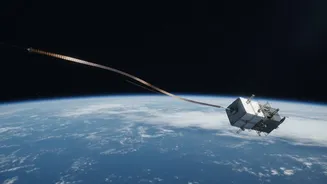
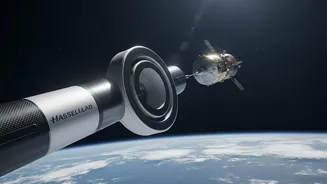
Magnetic capture is no longer just a theory. Several companies and space agencies are actively developing and testing this technology. The Japanese company Astroscale has already demonstrated a magnetic docking system in orbit with its ELSA-d mission, which successfully captured and released a client satellite using a magnetic plate. This system is designed for future satellites that are 'prepared' for removal with a built-in docking plate. The European Space Agency (ESA) and NASA have also explored magnetic capture as part of their debris removal and in-orbit servicing programs. For example, NASA has developed a magnetic docking system that can correct for significant misalignment during approach, reducing the risk of impact damage. Companies like Altius Space Machines are also developing technologies like the "MagTag," a magnetic interface for servicing and debris removal. These real-world tests are proving the viability of magnets as a primary tool for orbital cleanup.
The Future of a Sustainable Orbit
While magnetic probes are a powerful tool, they are not a silver bullet. The eddy current method works on any conductive material, but systems that rely on a pre-fitted ferromagnetic docking plate are most effective on satellites designed for de-orbiting. Cleaning up older, 'unprepared' legacy objects remains a huge challenge that may require a combination of technologies, including harpoons, nets, and robotic arms alongside magnetic systems. However, the rise of Debris Removal as a Service (DRAAS) business models, pioneered by partnerships like Portal Space Systems and Paladin Space, shows a shift toward making cleanup an operational, commercial service rather than a series of one-off experiments. By integrating magnetic docking plates into new satellites and developing versatile magnetic probes, the space industry is building the infrastructure for a more sustainable future, ensuring that low Earth orbit remains a valuable resource for generations to come.