


A New Era of Cosmic Vision
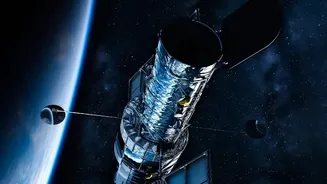
Before the James Webb Space Telescope, our ability to study rocky exoplanets was limited. Telescopes could find these planets, but figuring out if they had atmospheres, let alone what kind, was largely guesswork. JWST changed the game. With its massive
mirror and advanced infrared instruments, it can do something revolutionary: analyse the incredibly faint light that has passed through or been emitted by the atmosphere of a distant, Earth-sized world. This capability is pushing the frontiers of exoplanet characterization, allowing scientists to move beyond just detecting planets to truly beginning to understand them. It represents a new type of science, one that was impossible just a few years ago.
The Art of Reading Starlight
So how does Webb scan an atmosphere from light-years away? The primary method is called transmission spectroscopy. When a planet passes in front of its star from our perspective—an event called a transit—a tiny fraction of the starlight filters through the planet's atmosphere. Different gases and molecules absorb specific wavelengths, or colours, of light. By observing this filtered starlight, JWST can detect the chemical fingerprints left behind, telling scientists what the atmosphere is made of. Another method measures the heat energy given off by the planet itself. This thermal emission can reveal the planet’s temperature and hint at whether an atmosphere is present to distribute heat.
Lava Worlds with Surprise Atmospheres
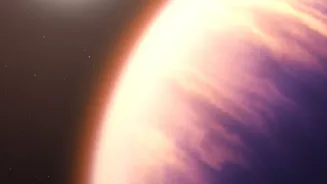
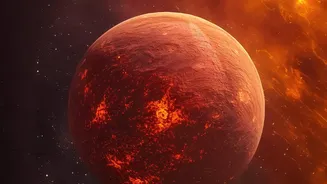
Some of the most startling revelations have come from planets that shouldn't, by all rights, have atmospheres at all. Take 55 Cancri e, a super-Earth so close to its star that its surface is a molten ocean of magma. Logically, the intense stellar radiation should have blasted any atmosphere away long ago. Yet, JWST found the best evidence to date for a substantial atmosphere surrounding this broiling world. Data suggests the presence of carbon monoxide or carbon dioxide, likely bubbling up from the magma ocean itself, constantly replenishing the atmosphere. Similarly, findings on another ultra-hot planet, TOI-561 b, challenged theories by showing signs of a thick atmosphere where none was expected. These discoveries force a rethink of how planets form and retain their gaseous envelopes.
The Silence of the TRAPPISTs
Just as revealing as finding an atmosphere is confirming its absence. The TRAPPIST-1 system, with its seven Earth-sized rocky planets, has been a prime target for JWST. It offers a natural laboratory for comparing worlds in and out of the habitable zone—the region where liquid water could exist. Early observations have delivered sobering news. Studies of the innermost planets, TRAPPIST-1 b and c, found them to be bare rock with no significant atmosphere. More recently, observations of TRAPPIST-1 d, which sits near the habitable zone, also found no evidence of a thick, Earth-like atmosphere. While disappointing for those hoping for a quick discovery of an Earth-twin, these results are scientifically vital. They help scientists understand the harsh realities of planetary evolution around small red dwarf stars.
The Complicated Search for Life
Ultimately, the goal of analysing these atmospheres is to find biosignatures—gases that could indicate the presence of life. This is far more complex than just finding water. For example, methane has been floated as a promising biosignature, but its presence can only be interpreted in the context of other gases. On Earth, the mix of oxygen and methane in our atmosphere is a strong sign of life, as they would normally react and destroy each other without being constantly replenished. On the exoplanet K2-18 b, Webb detected methane and carbon dioxide, which is exciting but not definitive proof of life. Scientists stress that finding life will be a process, requiring multiple lines of evidence to rule out non-biological explanations.