



What Is a Planetary Convergence?
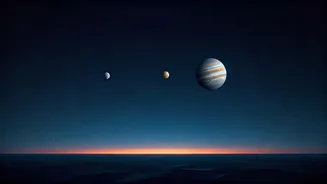
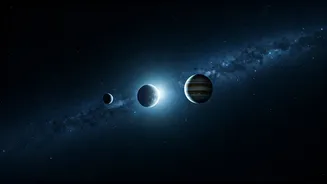
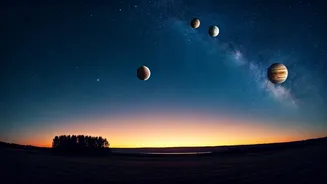
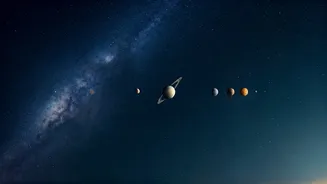
When we say planets are 'converging' or in 'conjunction', it doesn’t mean they are physically close to each other in space. In reality, they remain millions of kilometres apart. Instead, it’s a beautiful illusion of perspective. From our viewpoint on Earth,
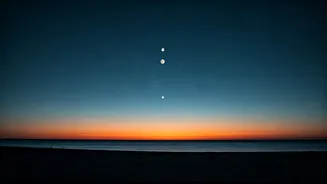
these planets appear to huddle together in a small patch of the sky as their orbits bring them into the same line of sight. These alignments, especially those involving three bright planets, are relatively rare and offer a fantastic opportunity for stargazers. It’s like seeing three distant friends waving from the same cosmic street corner, even though they are standing miles apart.
Meet the Celestial Trio
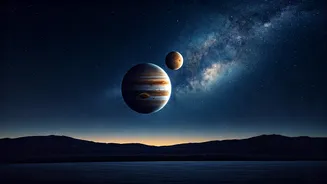
Each planet in this trio has a distinct personality. Venus is the undisputed star of the show. Often called the 'Evening Star' or 'Morning Star', it is the brightest object in the night sky after the Moon, shining with a brilliant, steady, silvery light. Jupiter, the largest planet in our solar system, will appear as a very bright, unwavering point of light, second only to Venus in its radiance. The trickiest one to spot is Mercury. As the innermost planet, it never strays far from the Sun’s glare. It will appear as a much fainter star, a fleeting presence low on the horizon. Spotting it is a true stargazer’s reward.
When and Where to Look
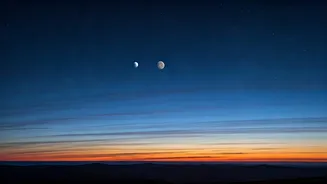
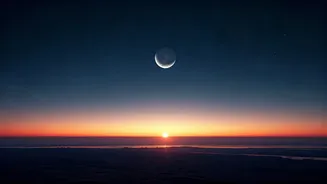
The key to catching this spectacle is timing. The best viewing window is a short one, starting about 30 to 45 minutes after sunset. As twilight deepens, the planets will become visible. You’ll need to look towards the west-northwest horizon, the same direction where the Sun just set. The planetary trio will be low in the sky, so an unobstructed view is essential. As the days progress during the event, their positions will shift slightly each night. Venus and Jupiter will be easy to spot first, with faint Mercury popping into view as the sky darkens but before the trio sinks below the horizon.
A Night-by-Night Guide
While the convergence lasts for several days, the arrangement changes nightly. Initially, you might see Jupiter and Venus appearing very close, with Mercury nearby. On subsequent nights, you can watch Mercury appear to climb higher to meet the other two, forming a tight celestial triangle. This dynamic dance is part of the fun. One night, they might form a neat line; the next, a compact bunch. Using a stargazing app on your phone can help you identify which planet is which, but Venus’s sheer brilliance will be your main signpost. Find it first, and the others will be in its immediate cosmic neighbourhood.
Tips for the Best View
You don’t need a fancy telescope to enjoy this show. In fact, your unaided eyes are perfectly fine. Binoculars, however, will offer a fantastic advantage. They will not only make the planets appear brighter and more detailed but will be especially helpful in pulling elusive Mercury out from the twilight glow. For the best experience, find a location with a clear view of the western horizon, away from tall buildings and bright city lights. Give your eyes about 15 minutes to adapt to the darkness. This will make it much easier to spot the fainter planets and appreciate the subtle colours of the twilight sky.