






From Cane to Kitchen: A Tale of Two Processes
Both jaggery and white sugar typically begin their journey as sugarcane juice, but their paths diverge significantly from there. White sugar undergoes an intensive industrial refining process. The juice is clarified, crystallised, and then centrifuged
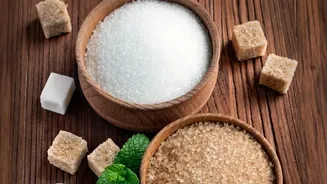
to strip away all molasses and natural pigments, resulting in nearly pure, white sucrose crystals. This process removes virtually all nutrients, leaving behind what many refer to as 'empty calories'. Jaggery, on the other hand, is made using a far more traditional and less intensive method. The sugarcane juice is simply boiled in large, open pans for hours. During this process, impurities are skimmed off the top, and the juice concentrates until it thickens. This thick liquid is then poured into moulds to solidify. Because it skips the heavy refining, jaggery retains its natural molasses content, which is responsible for its golden to dark brown colour, its distinct flavour, and its mineral content.
The Nutritional Showdown: More Than Just Sweetness?
This is where jaggery's reputation as a 'healthier' option comes from. Unlike white sugar, which contains no significant vitamins or minerals, jaggery does contain trace amounts of several important nutrients. A 100-gram serving of jaggery can provide notable amounts of iron, potassium, and magnesium. It also contains smaller quantities of calcium, zinc, and phosphorus. These minerals are preserved because the nutrient-rich molasses is not removed during processing. However, it is crucial to consider the portion size. While the mineral content per 100 grams seems impressive, a typical serving in a cup of tea or a sweet is closer to 10-15 grams. At this realistic serving size, the mineral contribution is quite small and not enough to meet your daily requirements. Therefore, while jaggery is certainly more nutritious than white sugar, it should not be considered a primary source of these essential minerals.
The Calorie Count and Blood Sugar Impact
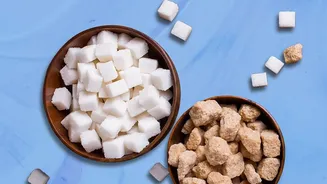
When it comes to calories, the difference between the two sweeteners is negligible. 100 grams of jaggery contains around 383 calories, while the same amount of white sugar has about 387 calories. Swapping one for the other will not have a meaningful impact on your total calorie intake. A more significant and often misunderstood point of comparison is the glycemic index (GI), which measures how quickly a food raises blood sugar levels. Contrary to popular belief, most sugarcane jaggery has a high GI, often cited as 84 or higher. This is actually higher than white sugar, which has a GI of around 65. This means that sugarcane jaggery can cause a faster and sharper spike in blood sugar than white sugar does. For this reason, people with diabetes are advised to avoid or strictly limit both jaggery and sugar, as neither is a 'safe' option.
Jaggery’s Role in Winter Wellness
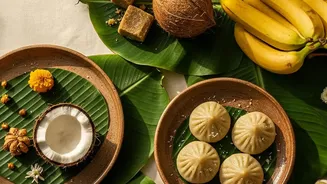
So why does jaggery consumption famously increase during Indian winters? The answer lies in both tradition and its perceived properties. In Ayurveda, jaggery is considered a 'warming' food, believed to help increase body temperature and provide comfort in cold weather. It is traditionally used in a variety of winter preparations, from til ke laddoo to warm drinks with ginger. Beyond its warming nature, jaggery is believed to act as a natural remedy for common winter ailments. It's often used to soothe a sore throat and help clear congestion from coughs and colds. Some also believe it aids digestion, which can become sluggish during the colder months when physical activity might decrease.
The Final Verdict: A Matter of Moderation
In the battle of jaggery versus white sugar, jaggery emerges as the marginally better choice, but not as the guilt-free health food it is sometimes made out to be. Its primary advantage is its mineral content and the fact that it is less processed. For those who enjoy its rich, caramel-like flavour, using it in traditional sweets or as a daily sweetener is a perfectly reasonable choice. However, the key takeaway is that jaggery is still a form of sugar. It is calorically dense and has a high glycemic index, meaning its impact on blood sugar is significant. The 'health halo' around jaggery can sometimes lead to overconsumption, which carries the same risks as consuming too much white sugar, including weight gain and an increased risk of metabolic issues.