
Why the Lunar South Pole?
The key to a long-term presence on the Moon lies in a concept called In-Situ Resource Utilization (ISRU), which essentially means living off the land. For decades, scientists suspected that the Moon held reserves of water, and missions have now confirmed
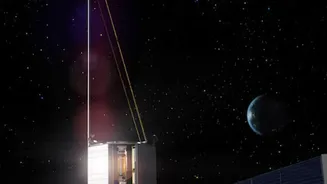
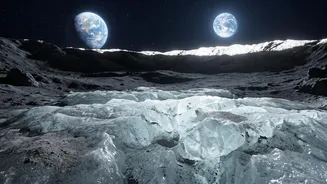
it. The prime real estate is the lunar South Pole. Because the Moon is tilted on its axis by only 1.5 degrees, the bottoms of deep craters in this region have not seen sunlight for billions of years. These Permanently Shadowed Regions (PSRs) act as cryogenic cold traps, preserving water ice delivered by comets and asteroids over eons. At the same time, the rims of these craters receive near-constant sunlight, providing an ideal location for solar panels to power a lunar base. This unique combination of abundant energy next to vast reserves of frozen water makes the South Pole the strategic heart of lunar settlement plans.
From Ice to Drinking Water
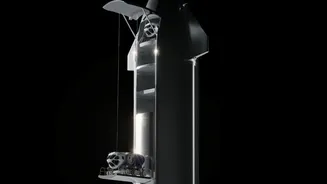
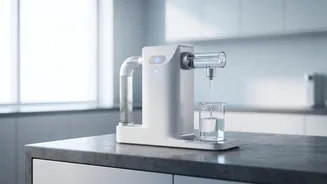
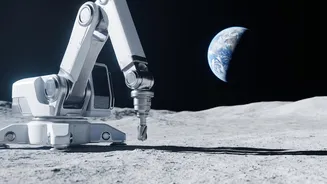
Harvesting this resource is a major engineering challenge. The water isn't a clean sheet of ice but is mixed with lunar soil, or regolith, in frigid temperatures that can drop below -220 degrees Celsius. NASA is developing robotic missions and technologies to excavate this icy regolith. One concept involves robotic rovers that would dig up the soil and transport it to a processing plant. There, the material would be heated in an oven. This process would cause the water ice to turn directly into vapor, a process called sublimation. The water vapor would then be captured and condensed back into liquid form. After purification to remove other trapped volatiles and fine lunar dust, this water becomes ready for use. Its most critical function would be for life support: providing drinking water for astronauts and supporting hydroponics for growing food.
The Ultimate Refill Station
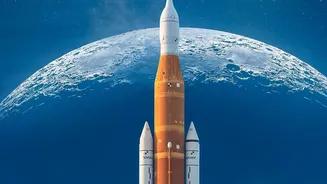
Beyond life support, lunar water holds the key to turning the Moon into a deep-space refueling depot. This is achieved through a well-understood process called electrolysis. By passing an electric current through the purified water (H2O), it can be split into its component elements: hydrogen and oxygen. When chilled to extremely low temperatures, these elements become liquid oxygen and liquid hydrogen, the primary components of powerful cryogenic rocket propellant. The ability to manufacture rocket fuel on the Moon would be revolutionary. Launching mass from Earth is incredibly expensive, largely because most of a rocket's weight is the fuel needed to escape our planet's strong gravity. Producing propellant on the Moon, which has only one-sixth of Earth's gravity, would dramatically reduce the cost and complexity of future missions, including journeys to Mars.
The Hurdles Ahead
While the science is sound, the engineering is formidable. Designing robotic miners that can operate reliably in the extreme cold and darkness of a PSR is a significant challenge. The abrasive, fine lunar dust is notoriously hard on machinery. Furthermore, any mining operation will require a substantial and continuous power source, likely a combination of large solar arrays on crater rims and energy storage systems to survive periods of darkness. NASA is actively testing technologies like the Polar Resources Ice Mining Experiment-1 (PRIME-1) and the CryoFILL system, which focuses on liquefying and storing the extracted oxygen. These experiments are crucial steps in proving that the 'dust-to-thrust' pipeline is not just a concept, but a practical foundation for a sustainable human future on the Moon and beyond.