


A planet 1,000 light-years away has seemingly vanished. For seven years, astronomers watched it orbit its star, and then it was gone. Now, a new study reveals the cosmic drama behind its disappearance, solving a compelling celestial mystery.
A Planet on an Unsteady Clock
Imagine trying
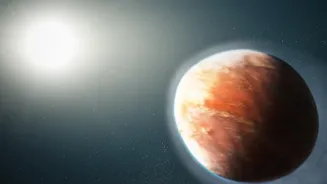
to set your watch by a clock that runs unpredictably fast or slow. That was the challenge astronomers faced with TOI-2535 b, a distant exoplanet located about 1,000 light-years from Earth. Classified as a 'hot Jupiter', this gas giant is similar in size to Jupiter but orbits its star in just over eight days, making it blisteringly hot. From April 2019 to March 2026, scientists used NASA's Transiting Exoplanet Survey Satellite (TESS) to watch it. TESS detects planets by looking for tiny, regular dips in a star's light, which occur when a planet passes in front of it—a process called a 'transit'. But TOI-2535 b was anything but regular. It often arrived for its transit up to six hours early or six hours late, a significant deviation that puzzled observers. This cosmic tardiness was the first clue that something unusual was happening in this far-off solar system.
The Vanishing Act of 2026
The mystery deepened dramatically in March 2026. After seven years of unsteady but consistent observations, TESS could no longer see the telltale dips in starlight from TOI-2535 b. From Earth's perspective, the planet had simply vanished. Planets don't just disappear. Their orbits, governed by the immense force of gravity, are typically as reliable as clockwork. The sudden absence of TOI-2535 b's signal sent researchers scrambling for an explanation. Had the planet been destroyed in some cataclysmic event, or was there another, more subtle force at play? The regular cadence of its transits had been a cornerstone of its study, and without it, the planet was effectively lost to our telescopes.
An Unseen Cosmic Neighbor
The solution to the mystery, detailed in a new study published in The Astrophysical Journal Letters, is a fascinating tale of gravitational influence. The research team concluded that TOI-2535 b is not gone at all; it has been pulled from view by a hidden accomplice. Data analysis suggests that an unseen planetary neighbor is exerting a powerful gravitational tug on TOI-2535 b. This constant pulling and pushing between the two worlds has caused the orbit of TOI-2535 b to 'wobble'. This interaction is not one-sided; the 'missing' planet is pulling back on its neighbor, creating a complex gravitational dance between the two. The planet wasn't lost, just temporarily hidden by the influence of a world we have yet to directly detect.
An Orbit Tilted Out of View
Scientists compare the effect of this gravitational tug to the wobble of a spinning top. As the hidden planet pulls on TOI-2535 b, it has gradually tilted its orbit. For us to see a transit, a planet's orbit must be perfectly aligned with our line of sight to its star. The wobble induced by the neighboring world tilted TOI_2535 b's orbit just enough that, from our viewpoint on Earth, it no longer crosses in front of its star. It's still there, faithfully circling its sun, but its path is now angled away from our view. Astronomers predict it will be at least another 30 years before its orbit wobbles back into an alignment that will allow us to witness its transit again.
What This Teaches Us About the Universe
This discovery does more than just solve a single mystery; it refines our understanding of how planetary systems work. It serves as a powerful reminder that solar systems are not always the neat, clockwork models we often imagine. The extreme wobble in the TOI–2535 system provides valuable clues about its formation. Hot Jupiters like TOI–2535 b are thought to form far from their stars and migrate inward over time. The presence of a close, influential neighbor suggests this planet may have spiraled in slowly rather than being violently thrown into its current position, offering insight into a formation path that may be rare but important. Each 'disappearing' planet is another lesson in the complex and dynamic nature of the cosmos.