




The Challenge: A Cosmic Haystack
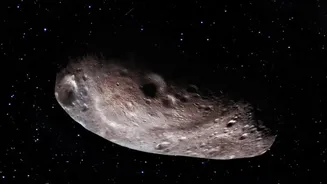
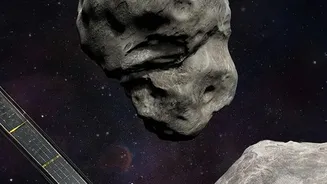
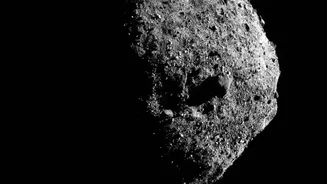
The solar system is filled with tens of millions of rocky bodies, from dust-sized particles to planetoids. The vast majority reside in the main asteroid belt between Mars and Jupiter. However, some are nudged by gravity into orbits that bring them close
to Earth, earning the label Near-Earth Objects (NEOs). Finding a potentially hazardous asteroid among these millions of moving dots, set against a backdrop of countless stars, is like finding a specific needle in a cosmic haystack. The first step is simply to detect any point of light that moves. Even through a powerful telescope, most asteroids appear as faint, star-like points, which is where the name 'asteroid'—meaning 'star-like'—originates. This initial detection is the foundation of all planetary defense efforts.
Rapid Imaging Reveals Motion
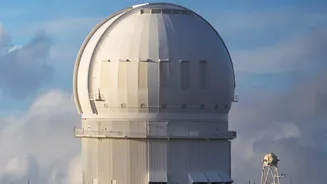
Modern asteroid-hunting telescopes are designed for speed and breadth. Surveys like the Panoramic Survey Telescope and Rapid Response System (Pan-STARRS) and the Zwicky Transient Facility (ZTF) repeatedly scan large portions of the night sky. They take a series of images of the same area, minutes or hours apart. When these images are compared, the distant stars remain fixed, but any closer object, like an asteroid, will have moved slightly. This blinking or streaking effect is the tell-tale sign of a nearby object. The upcoming Vera C. Rubin Observatory in Chile is set to revolutionize this process. It will survey the entire southern sky every few nights with its enormous 3,200-megapixel camera, discovering millions of new asteroids and spotting fainter, more distant objects than ever before.
Software Does the Heavy Lifting
Human eyes could never sift through the sheer volume of data produced each night. A facility like Pan-STARRS can generate enough data to fill 1,000 DVDs every single night. This is where sophisticated software becomes essential. Algorithms are designed to automatically comb through the image sets, flagging any object that has changed position. These programs, such as Astrometrica, allow astronomers to measure the object's position and speed accurately. New algorithms like HelioLinc3D, developed for the Vera C. Rubin Observatory, are even more powerful. They can identify asteroids from fewer observations than previously required, meaning even objects that are only spotted a couple of times can be successfully tracked.
Asteroid, Comet, or Space Junk?
Once a moving object is found, the next step is to figure out what it is. The key difference between an asteroid and a comet is composition. Asteroids are primarily rock and metal, while comets are 'dirty snowballs' made of rock, dust, and ice. As a comet gets closer to the sun, its ice sublimates (turns directly into gas), creating a fuzzy cloud called a 'coma' and sometimes a tail. High-precision telescopes can often resolve this coma, immediately identifying the object as a comet. If there's no coma, another powerful technique is spectroscopy. By analyzing the spectrum of light reflected off the object's surface, scientists can identify the minerals present, such as olivine and pyroxene, confirming its rocky, asteroidal nature. Differentiating from man-made space debris is usually done by analyzing the object's orbit. Satellites and junk have predictable orbits around Earth, whereas asteroids follow orbits around the sun.
The Future of Planetary Defense
The combination of wide-field, rapid-fire imaging and powerful data-processing software has transformed our ability to catalogue our solar system. Observatories like the Vera C. Rubin Observatory will help achieve the goal of finding nearly all potentially hazardous asteroids larger than 140 meters. While smaller objects that could cause local damage are harder to spot and often found with only weeks of warning, the comprehensive sky surveys give us the best possible chance to identify threats. These telescopes not only help protect our planet but also provide invaluable data on the formation of our solar system, as each asteroid is a leftover building block from its earliest days. They are our sentinels in the dark, patiently watching the skies to keep us safe and unlock the secrets of our cosmic past.