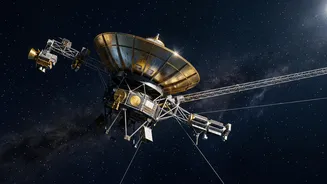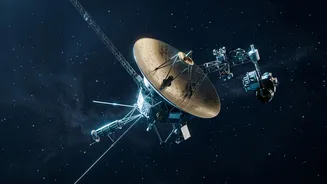



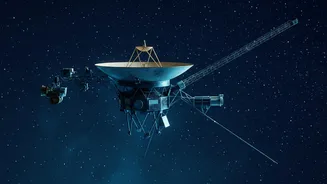
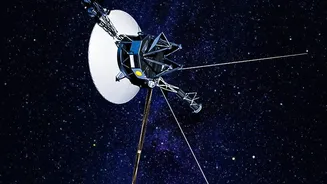
Humanity's farthest messenger, Voyager 1, is once again communicating clearly after a series of dramatic technical challenges. As NASA engineers work to conserve its fading power, the resilient probe is closing in on an unprecedented milestone.
A Garbled Message From the Void
In November
2023, the steady stream of data from Voyager 1, traveling through interstellar space, suddenly turned to gibberish. For nearly five decades, the probe had been humanity's reliable eyes and ears in the outer solar system and beyond. Now, its transmissions were a nonsensical, repeating pattern of ones and zeros, leaving the mission team at NASA's Jet Propulsion Laboratory (JPL) in suspense. The spacecraft was still receiving commands, but its replies were useless. The problem was traced to the Flight Data Subsystem (FDS), one of three onboard computers responsible for packaging science and engineering data for the long journey back to Earth. With a 45-hour round-trip communication delay, troubleshooting was a slow, deliberate process of sending a command and waiting nearly two days for a response.
An Interstellar Repair Job
What followed was a masterclass in long-distance diagnostics. Relying on 50-year-old documents, engineers had to piece together the problem from 15 billion miles away. After months of painstaking work, they sent a command—a 'poke'—in March to try and get the FDS to send a memory readout. The plan worked, revealing that a single memory chip, holding about 3% of the FDS memory, had failed. This was likely due to damage from a cosmic ray or simply old age. Since repairing the chip was impossible, the team devised an ingenious workaround. They painstakingly segmented the affected code and found new places to store it within the FDS's limited memory. The code was split up and tucked into different locations, and then updated to ensure all the parts still worked together as a whole. By June 2024, after a series of remote uploads, all four of Voyager 1's active science instruments were back online, returning usable data from interstellar space.
Racing Against Fading Power
Even as engineers solved the FDS crisis, they faced another, more relentless challenge: dwindling power. Voyager 1 is powered by radioisotope thermoelectric generators (RTGs), which convert heat from decaying plutonium into electricity. But the power output declines by about 4 watts each year, forcing NASA to make difficult choices. Over the years, engineers have shut down various instrument heaters and non-essential systems to keep the probe alive. In a recent power-saving maneuver in September 2026, nicknamed the 'Big Bang', the team swapped several devices for lower-power alternatives to extend the operational life of the remaining science instruments. This delicate balancing act is crucial to ensuring Voyager 1 can continue its scientific mission for as long as possible, with current estimates suggesting it could last into the early 2030s.
The One-Light-Day Milestone
Amid these engineering triumphs, Voyager 1 is approaching a milestone of cosmic proportions. On November 18, 2026, the spacecraft will become the first human-made object to be one light-day away from Earth. This means it will take 24 hours for a radio signal, traveling at the speed of light, to cover the 16.1 billion miles (25.9 billion kilometers) separating the probe from its creators. The milestone itself won't be felt by the spacecraft, but it serves as a profound marker of its incredible journey and the sheer vastness of space. For the mission team, it underscores the operational challenge: every message sent is a shout into the void, with a twonday wait for any reply. This achievement is a testament to the endurance of a machine launched in 1977, now exploring a region of space no other probe has reached.