



Piercing the Cosmic Dust
The single biggest challenge in observing star formation is the environment where it happens. Stars are born inside vast, cold, and incredibly dense clouds of gas and dust known as stellar nurseries. These clouds are opaque to visible light, meaning telescopes
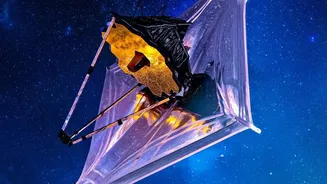
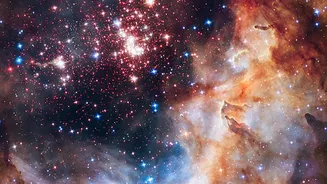
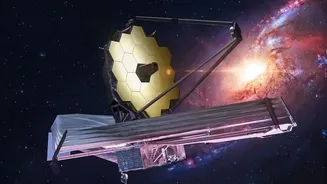
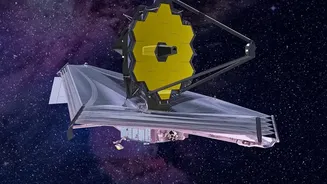
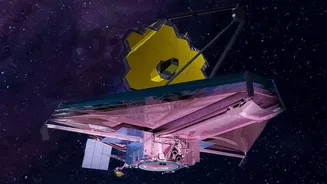
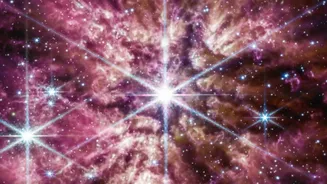
like Hubble could only see the exterior surfaces, much like looking at the outside of a cloud on Earth. The JWST, however, was designed specifically to overcome this obstacle. It observes the universe in infrared light. These longer wavelengths of light can pass through the dense dust clouds, allowing astronomers to finally see the processes unfolding deep inside. What were once dark, impenetrable smudges in the sky are now resolving into detailed landscapes of creation, revealing hundreds of stars that were previously completely hidden.
Cosmic Cliffs and Sculpted Nurseries
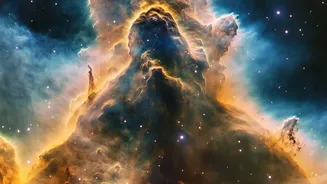
One of the most breathtaking early images from JWST was the “Cosmic Cliffs” of the Carina Nebula. What looks like a mountain range on a starry night is actually the edge of a giant, gaseous cavity being carved out by intense ultraviolet radiation from massive young stars located just out of frame. This intense energy eats away at the nebula wall, but it also triggers new star formation in the process. With its infrared vision, Webb peers through the “steam” rising from the cliffs—which is actually hot gas and dust streaming away—to spot newborn stars and their tell-tale signatures. We can now see bubbles, cavities, and pillars of gas resisting this erosion, all while protostars, the earliest stage of stars, are actively forming within these dense structures. It’s a dynamic environment where creation and destruction are happening side-by-side.
The Outbursts of Baby Stars
One of the most dramatic phenomena JWST is revealing is the powerful jets and outflows shot out by protostars. As a young star gathers mass from a surrounding disk of gas and dust, it violently ejects a fraction of that material in powerful, opposing jets. These jets, traveling at hundreds of kilometres per second, slam into the surrounding molecular cloud, creating brilliant shockwaves. In a remarkable discovery in the Serpens Nebula, JWST observed a whole cluster of these outflows all aligned in the same direction. Astronomers believe this provides a “historical record” of star birth, suggesting these stars formed from the same rotating filament of gas and inherited its spin, like cosmic siblings all kicking in the same direction.
Uncovering Binary Stars and Tiny Worlds
The telescope’s sharp resolution has also overturned previous assumptions. In several cases, regions thought to contain a single forming star have been revealed to be a pair, known as a binary protostar. This is crucial because a large fraction of stars in the Milky Way exist in binary or multiple-star systems, and understanding their formation is key to understanding stellar populations as a whole. Furthermore, JWST’s sensitivity allows it to detect extremely faint, low-mass objects that were difficult to spot before. It has found free-floating, Jupiter-sized objects and brown dwarfs—often called “failed stars”—in stellar nurseries. By studying these smallest objects, scientists are probing the very limits of the star formation process, learning the minimum amount of material required to kickstart a cosmic engine.
The Chemical Recipe for Planets
Beyond just imaging stars, Webb is a powerful tool for astrochemistry. Using its spectroscopic instruments, it can analyze the chemical composition of the material around protostars. In these cold, dense clouds, it has confirmed the presence of various ices, including frozen water. Even more excitingly, it has made robust detections of complex organic molecules—the building blocks of life as we know it—in the icy material surrounding protostars before planets have even formed. Molecules like ethanol (alcohol) and acetic acid (the main component of vinegar) have been identified, suggesting that the fundamental ingredients for habitable worlds are delivered to nascent planetary systems right from the start. Webb is essentially reading the recipe for future planets and, perhaps, for life.