


A Sweet Discovery in a Harsh Place
Scientists using powerful radio telescopes have detected the chemical fingerprints of simple sugars in vast molecular clouds thousands of light-years away. One of the most significant finds is in Sagittarius B2, a dense star-forming region near the Milky
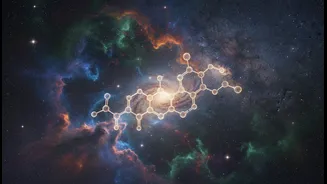
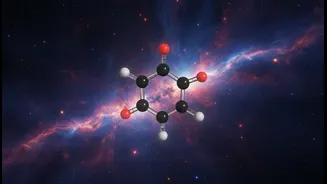
Way's core. The molecules found aren't exactly the sugar you'd put in your morning tea. One key discovery is glycolaldehyde, the simplest possible sugar molecule. More recently, astronomers detected erythrulose, a more complex four-carbon sugar also found in raspberries, within a molecular cloud named G+0.693-0.027. These discoveries are remarkable because these clouds are incredibly cold and diffuse, with temperatures hovering just a few degrees above absolute zero, an environment once thought too harsh for such complex chemistry to occur.
The Galaxy's Molecular Kitchen
So how does sugar form in the freezing vacuum of space? The process is a form of slow, cold chemistry that takes place over millions of years. Tiny interstellar dust grains act like microscopic assembly stations. Simpler atoms and molecules, like water, carbon monoxide, and methanol, freeze onto the surfaces of these dust grains, forming icy mantles. Over time, the faint but persistent energy from cosmic rays and ultraviolet light from distant stars provides just enough of a nudge to trigger chemical reactions within these icy layers. Atoms link up, forming more complex structures. This process, happening on countless dust grains, gradually populates these giant clouds with an impressive inventory of organic molecules, including the precursors to life. The discovery of erythrulose suggests that some molecules might even form through the combination of other, simpler organic compounds on these icy surfaces.
From Interstellar Dust to New Worlds
These chemically-enriched clouds are the very nurseries where new stars and planets are born. As gravity causes a cloud to collapse and form a protostar, a rotating disk of gas and dust—a protoplanetary disk—forms around it. This is the raw material for future planets. The sugar-coated dust grains are swept up into this disk. As the material clumps together to form asteroids, comets, and eventually planets, it carries its precious organic cargo with it. This means that planets can be seeded with the basic ingredients for life from the very moment they form. The detection of molecules like methyl cyanide in protoplanetary disks confirms that these building blocks not only survive the chaotic process of star formation but can even be created within it.
The Raw Ingredients for Life
Sugars are fundamental to life as we know it. They form the structural backbone of RNA and DNA, the molecules that carry our genetic code. Finding them in interstellar space supports a compelling theory about the origin of life on Earth. Rather than life’s building blocks forming exclusively in Earth’s primordial soup, it’s possible they were delivered to our young planet by comets and asteroids. These celestial bodies are essentially pristine leftovers from the formation of the solar system, carrying a chemical snapshot of the interstellar cloud from which our Sun was born. The fact that sugars and other prebiotic molecules like amino acid precursors are abundant in these clouds suggests that the potential for life might not be a rare occurrence. The chemical toolkit appears to be universal.