



What Is a VR Classroom?
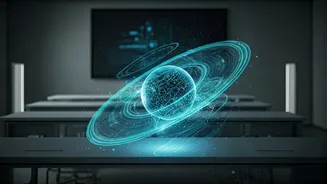
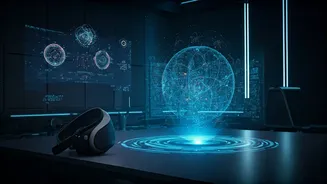
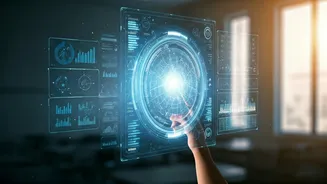
Forget rows of desks and a dusty chalkboard. A Virtual Reality (VR) classroom is an immersive, 3D digital environment. Students put on a headset and are instantly transported into a simulation. Instead of reading about planetary orbits, they can stand
in space and watch them happen. It’s the difference between looking at a map and actually exploring a city. In this context, the ‘classroom’ is a limitless laboratory where the laws of physics are not just rules on a page, but tangible forces you can interact with. You can shrink down to the size of an atom or travel at the speed of light, making the most abstract concepts feel real and immediate.
Where Predictive AI Fits In
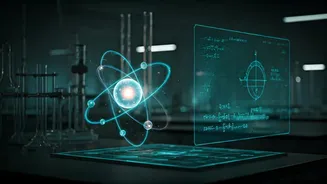
This is where the real magic happens. The AI in these systems is more than just a programme running the simulation; it’s a predictive tutor. As a student interacts with the virtual world—say, by trying to build a stable atomic nucleus or bending spacetime with a virtual black hole—the AI analyses their actions in real time. It predicts their intentions, identifies potential misunderstandings before they become frustrating roadblocks, and subtly adjusts the environment to guide them. If a student consistently struggles with a concept, the AI can introduce tailored hints, simplify the simulation, or offer a different visual perspective. It’s like having a patient physics professor for every single student, offering personalised feedback instantly.
From Equations to Intuition
The greatest challenge in physics education is bridging the gap between mathematical equations and real-world intuition. This technology excels at doing just that. Imagine trying to understand electromagnetic fields. A textbook gives you Maxwell's equations. A VR simulation lets you physically ‘see’ the field lines radiating from a magnet and watch how they change as you move it. Students can experiment with concepts like quantum tunnelling, not by solving a probability wave function, but by repeatedly throwing a virtual ball at a wall until it, impossibly, appears on the other side. This hands-on experimentation builds a deep, intuitive ‘feel’ for the subject that rote learning can never achieve. It turns physics from a list of facts to memorize into a set of rules to discover.
More Than Just Passing Exams
While this technology can certainly help students score better on tests, its true potential lies in fostering a new kind of scientific thinking. Traditional education often rewards memorisation. A VR environment powered by predictive AI rewards curiosity, experimentation, and resilience. When students can fail safely in a simulation—when their bridge collapses or their rocket veers off course—they learn to analyse the problem and try again. This process cultivates the critical thinking and problem-solving skills that are essential for future scientists, engineers, and innovators. It shifts the goal from finding the ‘right answer’ in a book to understanding why the answer is right.
The Road Ahead in India
The adoption of such advanced technology faces hurdles, primarily cost and accessibility. High-end VR headsets and the powerful computers needed to run them are not yet standard in most schools. However, the potential for the Indian education market is immense. As hardware becomes cheaper and more accessible, these virtual labs could become a cornerstone for STEM-focused institutions and the competitive coaching industry. For a nation that produces millions of engineering and science graduates each year, tools that can provide a deeper, more intuitive grasp of fundamental principles represent a significant competitive advantage. Early pilots in premier institutes could pave the way for wider adoption, revolutionising how we prepare the next generation of innovators.