


A Cosmic Oddity Next Door
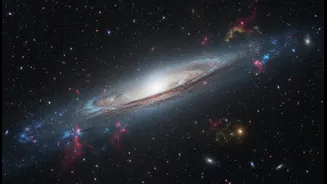
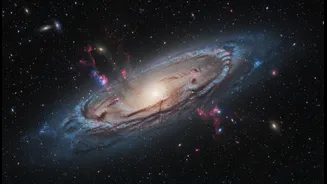
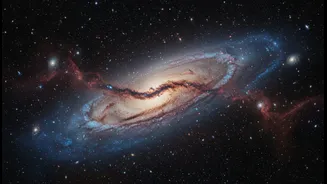
At about 11 to 13 million light-years away, Centaurus A is one of our closest galactic neighbours. But it's far from ordinary. First noted for its strange appearance in 1847, it looks like a giant elliptical galaxy sliced in half by a dark, thick band
of dust. This peculiar structure is the result of a violent cosmic collision. For decades, that very dust has blocked our view of the galaxy's heart. While observatories like the Hubble Space Telescope gave us stunning views in visible light, the core remained shrouded. Even earlier infrared telescopes like Spitzer lacked the sharpness to see the fine details hidden within. But where other telescopes see an opaque barrier, the James Webb Space Telescope (JWST) sees a transparent window, fundamentally changing our understanding of this celestial object.
The Power of Infrared Vision
Seeing in infrared is like having a superpower. Much of the universe is filled with gas and dust that acts like a cosmic fog, scattering and absorbing visible light. This is especially true in regions where stars are born and where galactic centres churn with activity. Infrared light, which has longer wavelengths than visible light, can travel through these dense clouds without being scattered. This allows telescopes like JWST to peer into the dusty cores of galaxies and witness processes that are otherwise completely hidden from view. The new images of Centaurus A, released to mark the telescope's fourth anniversary of science operations, are a perfect demonstration of this capability, transforming what was once a hazy glow into a landscape of millions of individual stars.
Anatomy of a Galactic Collision
The latest images from JWST provide the clearest evidence yet that Centaurus A is the product of a cataclysmic merger between a large elliptical galaxy and a smaller spiral galaxy. This cosmic crash, which likely happened around two billion years ago, left behind a scarred and warped disc of gas and dust that forms the prominent dark lane we see today. With Webb's astonishing resolution, astronomers can now resolve this messy interior star by star. This turns the study of Centaurus A into a form of galactic archaeology. By distinguishing between different generations of stars—those that existed before the merger, those born during the collision, and those formed since—scientists can piece together a detailed timeline of the galaxy's violent history.
Feeding a Monster Black Hole
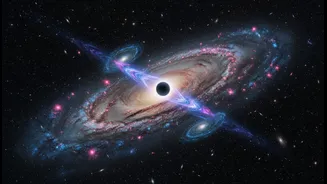
At the heart of Centaurus A lies a supermassive black hole, weighing in at about 55 million times the mass of our Sun. This behemoth is not dormant; it is actively feeding on the gas and dust funnelled towards it by the galactic merger. As it consumes this material, the black hole unleashes enormous jets of particles that travel at nearly half the speed of light, blasting thousands of light-years into space. The new infrared views help astronomers understand the complex interplay between this central engine and the rest of the galaxy. They can now see intricate filaments and glowing clouds of warm dust that trace the fuel flowing towards the black hole and witness how its explosive output shapes the surrounding environment, both triggering and suppressing the birth of new stars.