



What is a Solar Storm?
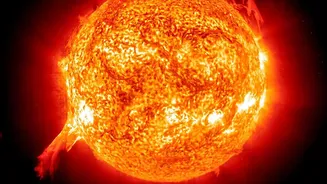
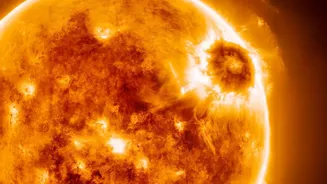
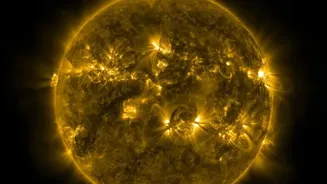
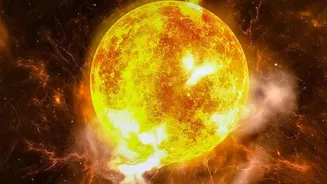
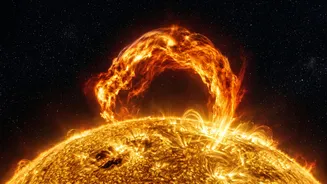
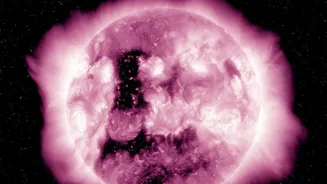
A solar storm is a powerful eruption on the Sun's surface. These events can take a few forms, but the most impactful are solar flares and coronal mass ejections (CMEs). A solar flare is an intense burst of radiation, while a CME is a massive cloud of magnetised
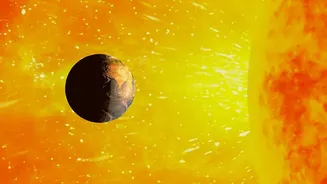
plasma and charged particles hurled into space at incredible speeds. While the Sun releases this material in all directions, sometimes it comes straight at Earth. When a CME hits our planet, it interacts with Earth's magnetic field, creating what's known as a geomagnetic storm. This disturbance is what poses a threat to our technology.
The Threat to Our Digital World
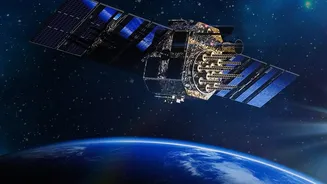
In a nation as digitally ambitious as India, the threat from space weather is significant. A powerful geomagnetic storm can induce excess currents in power grids, potentially damaging transformers and causing widespread, long-lasting blackouts. Satellites, which are crucial for everything from communication and television broadcasting to our own NavIC navigation system, are highly vulnerable. Charged particles can damage sensitive electronics, and the storms can increase atmospheric drag, causing satellites to fall out of orbit. This could disrupt mobile networks, GPS services, and financial transactions, impacting daily life and the economy in a profound way.
The Challenge of Early Prediction
For decades, accurately predicting when and where a solar storm will hit has been incredibly difficult. While we can see eruptions on the Sun, knowing which ones will cause a significant geomagnetic storm on Earth and pinpointing their impact area has been a major challenge. Previous models were often too slow or could only provide forecasts for specific locations, not a global picture. To effectively protect our infrastructure, operators need timely and precise warnings, something that has been just out of reach—until now.
Enter AI: NASA's New Warning System
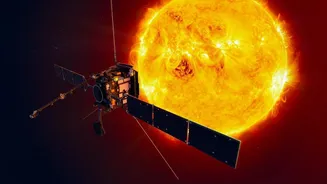
NASA is now leveraging artificial intelligence to change the game. One of the most promising new tools is a model called DAGGER (Deep Learning Geomagnetic Perturbation). By training on vast amounts of data from NASA satellites, DAGGER can predict where a solar storm will strike anywhere on Earth with a 30-minute advance warning. It can generate a worldwide forecast in less than a second and updates it every minute. That 30-minute window is crucial. It provides enough time for power grid operators to reroute power, satellite controllers to put spacecraft into a protective safe mode, and airlines to divert flights away from affected areas, preventing catastrophic damage.
A Strong Indian Connection
What makes this breakthrough even more relevant for India is the direct involvement of Indian scientific talent. The lead author of the research paper on the DAGGER model is Vishal Upendran, a researcher from the Inter-University Center for Astronomy and Astrophysics in Pune. His work has been instrumental in developing this global warning system. According to Upendran, this AI makes it possible to make rapid and accurate global predictions that can inform decisions and help prevent devastation to modern society. In another nod to India, a separate but related NASA AI model developed with IBM to analyse the Sun itself is named 'Surya'—the Sanskrit word for the Sun.
The Future of Space Weather Alerts
The development of AI like DAGGER is happening at a critical time. The Sun is currently heading towards its 'solar maximum,' the peak of its 11-year activity cycle, which means more frequent and intense solar storms are expected. With open-source models like DAGGER, companies and government agencies in India can adopt this technology to build customized alert systems for our specific infrastructure needs. Just as we have sirens for cyclones and tsunamis, we are now entering an era where we can have advanced warnings for storms originating from space, giving us a fighting chance to protect our hyper-connected world.