


Meet SHAPE: Earth's Cosmic Mirror
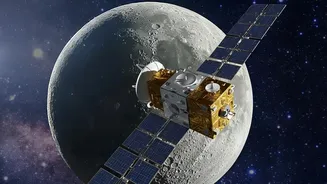
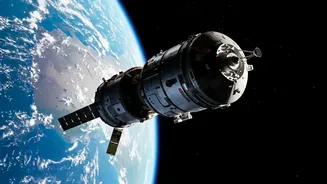
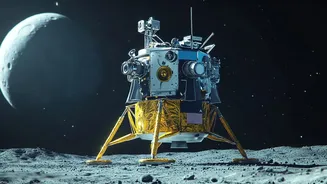
Tucked away on the Chandrayaan-3 Propulsion Module, which carried the lander and rover to lunar orbit, was a unique scientific instrument called SHAPE. The name is an acronym for Spectro-polarimetry of HAbitable Planet Earth. Unlike the other payloads
destined for the lunar surface, SHAPE’s primary job was to stay in orbit and observe Earth. It was the only scientific instrument on the Propulsion Module, added as a value-driven experiment to make the most of the journey. Its core purpose was to study the light reflected from our home planet, analysing it in minute detail from the unique vantage point of lunar orbit. This observation wasn't just about admiring the view; it was a dress rehearsal for studying distant, Earth-like planets in other solar systems.
How It Works: Reading Light's Secrets
SHAPE was designed to perform two key measurements: spectroscopy and polarimetry. Think of spectroscopy as breaking down light into its constituent colours, like a prism creating a rainbow. This spectrum reveals the chemical composition of what the light passed through or reflected off. For Earth, this means detecting the signatures of gases in our atmosphere, like water vapour. Polarimetry, on the other hand, measures the orientation of light waves. When light reflects off a surface, like clouds or oceans, its waves become polarized. By measuring this, scientists can learn about the particles and surfaces that scattered the light, helping to identify clouds and distinguish them from a planet's surface. SHAPE performs these measurements in the near-infrared wavelength range (1.0 to 1.7 micrometres), which is ideal for detecting key markers of habitability.
Why Study Earth from the Moon?
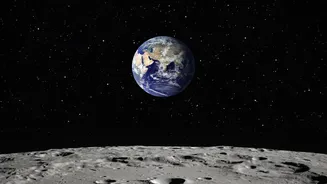
Observing Earth from hundreds of thousands of kilometres away provides a unique perspective. From that distance, Earth appears as a single, unresolved point of light, much like how we currently view exoplanets orbiting distant stars. By studying this 'disc-integrated' light, ISRO scientists can create a detailed catalogue of what a habitable, life-bearing planet looks like from afar. They can document how Earth's light signature changes as the planet rotates, as different surfaces (oceans, continents, forests) come into view, and as cloud cover shifts. This data creates a vital benchmark. When future powerful telescopes look at an exoplanet and see a similar light signature, they will have a reliable template to compare it against, helping them determine if that distant world might also harbour continents, oceans, and an atmosphere.
The Grand Goal: A Guide for Finding Other Earths
The ultimate goal of the SHAPE experiment extends far beyond our solar system. It is designed to provide critical data that will aid in the search for extraterrestrial life and habitable worlds. Future missions, like NASA's planned Habitable Worlds Observatory, will aim to directly image Earth-like exoplanets. These will be faint, distant targets, and interpreting the data they send back will be incredibly challenging. The information gathered by SHAPE provides a 'cheat sheet' for this cosmic quest. By thoroughly characterising the spectro-polarimetric signatures of our own known habitable planet, scientists will be better equipped to interpret the faint signals from potential new Earths. SHAPE's findings will help answer foundational questions like: what does the combined light from an oxygen-rich atmosphere, water-vapour-filled clouds, and a rocky-and-wet surface look like from 30 light-years away? Thanks to this clever experiment, we’ll have a much better idea.
A Second Life: A New Orbit for SHAPE
After successfully delivering the Vikram lander and Pragyan rover, the Propulsion Module's primary mission was complete. However, with significant fuel still available, ISRO executed a series of manoeuvres to move the module from lunar orbit into a high orbit around Earth in late 2023. This bonus mission extension allows SHAPE to continue its valuable work, observing Earth from various distances and angles. This not only gathers more data for exoplanet studies but also serves as a valuable demonstration for future mission strategies, such as sample return missions that would require a spacecraft to travel from the Moon back to Earth orbit.