





Sunlight Has a Push?
It sounds impossible, but it’s true: sunlight exerts a tiny, physical push. Light is made of particles called photons. While photons have no mass, they do have momentum. When a photon strikes a surface, it transfers that momentum, creating a very small
force. If the surface is reflective, like a mirror, the photon bounces off, transferring even more momentum—a bit like a billiard ball banking off a rail. This effect is called radiation pressure. On Earth, this force is imperceptible, but in the frictionless vacuum of space, it adds up. With a large enough surface, the constant push from countless photons can gently but continuously accelerate a spacecraft.
Not Your Average Sailboat
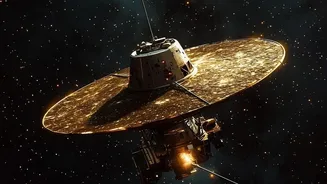
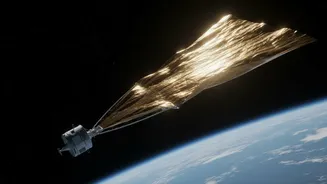
A solar sail is an incredible piece of engineering, designed to be both enormous and astonishingly lightweight. To catch enough sunlight, these sails must have a massive surface area, sometimes covering the size of a boxing ring or even a basketball court. Yet, they must also be incredibly thin and light to be accelerated effectively. The materials used are typically durable, reflective plastics like Mylar or a polyimide film, coated with an ultra-thin layer of aluminum. The sail for The Planetary Society’s LightSail 2, for instance, was just 4.5 microns thick—about one-fifth the thickness of a human hair. These massive, feather-light structures are packed into a small satellite and unfurled in space using lightweight, deployable booms.
From Theory to Reality
The idea of sailing on light has been around since the 17th century, but turning it into a working technology has been a modern challenge. Japan’s Aerospace Exploration Agency (JAXA) achieved the first major success in 2010 with its IKAROS spacecraft, which successfully demonstrated controlled solar sailing in interplanetary space. Following this, NASA’s NanoSail-D and The Planetary Society’s crowdfunded LightSail 1 and LightSail 2 missions proved the technology was viable, even for small satellites. LightSail 2, which operated from 2019 to 2022, successfully used its sail to change its orbit around Earth, propelled only by sunlight. These missions have moved solar sails from a theoretical concept to a proven method of propulsion.
The Sustainable Advantage
The most significant advantage of a solar sail is that it requires no propellant. Traditional spacecraft are limited by the amount of chemical fuel they can carry, which accounts for a huge portion of their launch weight and cost. Once that fuel is gone, the mission is effectively over. Solar sails, however, offer continuous acceleration for as long as they are exposed to sunlight. This makes them a truly sustainable and cost-effective option for long-duration missions. While the initial push is gentle, the constant acceleration allows a solar sail-powered craft to eventually reach very high speeds, making it ideal for missions that are not time-critical, like deep space observation or asteroid reconnaissance.
Where Do We Sail From Here?
With the core technology proven, space agencies are looking at bigger and more ambitious applications. NASA has been developing advanced composite materials to create larger and more robust sails, such as the ACS3 mission launched in 2024. These next-generation sails could enable new types of missions, like placing space weather observatories closer to the Sun for earlier storm warnings or sending probes to hover over the Sun's poles—a feat nearly impossible with conventional rockets. There are even concepts for using powerful ground-based lasers to push sails to interstellar destinations, offering a potential pathway to the stars. While still an emerging technology, solar sailing is unlocking a new, more sustainable era of cosmic exploration.